Author: Veronica Charalambous

EUPP5 Capacity Building Workshops Series: Supporting Youth Wellbeing

The EU Presidency Project 5 (EUPP5) Capacity Building Workshops Series, coordinated by CARDET, successfully launched their first workshops with a focus on “Youth and Wellbeing”. The workshops addressed mental health literacy, resilience, positive psychology, and the creation of supportive environments, reaffirming the importance of youth wellbeing as a strategic investment in the future.


Μέσα στον Φεβρουάριο ολοκληρώθηκαν με επιτυχία τα εργαστήρια της σειράς EUPP5 Capacity Building Workshops Series: «Νέοι και Ευζωία». Η θεματική ανέδειξε τη σημασία της ψυχικής ενδυνάμωσης των νέων, εστιάζοντας σε ουσιαστικά ζητήματα όπως: εγγραμματισμός ψυχικής υγείας, διαχείριση άγχους και συναισθημάτων, ενίσχυση ψυχικής ανθεκτικότητας, πρακτικές θετικής ψυχολογίας, δημιουργία ασφαλών και υποστηρικτικών περιβαλλόντων.

Τα εργαστήρια υλοποιήθηκαν στο πλαίσιο του ευρωπαϊκού έργου EU Presidency Project 5 (EUPP5), το οποίο στην Κύπρο συντονίζεται από το CARDET και τέλεσαν υπό την αιγίδα της Κυπριακής Προεδρίας του Συμβουλίου της Ευρωπαϊκής Ένωσης.

Θερμές ευχαριστίες στην εκπαιδεύτρια Άντρη Αγαθοκλέους για την πολύτιμη συμβολή και σε όλους τους συμμετέχοντες για την ενεργή παρουσία και τη δημιουργική ανταλλαγή απόψεων. Η επένδυση στη ψυχική ευημερία των νέων είναι επένδυση στο μέλλον.

Successful completion of the first Wellbeing Champions training within the Thriving Schools project

The first training of the Wellbeing Champions was successfully completed on 5 February 2026, within the framework of the European project Thriving Schools, implemented in Cyprus by CARDET and the Institute of Development (IoD).

The training was delivered through a combination of in-person and online sessions and involved the participation of 25 teachers from five schools. Educators with vision, sensitivity, and a genuine commitment to contribution took the first decisive step towards creating a shared language, understanding, and practice around wellbeing within the school community.

This training marks a significant milestone, as for the first time in Cyprus, a holistic Whole School Approach is being implemented within the Thriving Schools project for the systematic cultivation of a wellbeing culture at the school-unit level. The aim of this approach is to enhance the wellbeing of all members of the school community, including students, teachers, school leadership, and families.

The Thriving Schools project is implemented as part of a two-year pilot research study, involving more than 40 schools from Cyprus, Greece, Italy, and Romania. School teams will receive continuous and meaningful support from an interdisciplinary team of psychologists and researchers, acknowledging that changing school culture requires time, care, and collaboration.

The project aims to improve the mental health and wellbeing of students and teachers by strengthening social and emotional skills and enhancing the overall school climate. The intervention is based on a scientifically evidence-based framework, the strengthening of educational capacity, and the application of the PERMA model and Positive Psychology interventions.

More information about the project is available on the website: https://thrivingschools.eu/ 

Mental Health Support for Cyprus’ Children and Young People is an Urgent National Priority

Childhood is a critical time both for diagnosing mental health disorders and getting help. Around half of mental health disorders begin before age 14, and three quarters before 25[1]. When systems fail to support children and young people, they miss the most effective window of opportunity for prevention, early intervention and recovery.

Ensuring children and young people have access to support is an urgent national priority. It is especially critical that help is available as soon as problems arise: lack of early support can have lifelong consequences for children, families and societies at large.

A survey[2] conducted through face-to-face interviews with 500 young people aged 18-35 in Cyprus offers a glimpse into how mental health challenges can manifest in early adulthood. An astonishing seven in eight young people reported feeling high levels of anxiety and uncertainty about the future, and three quarters reported feeling pressure and stress. Mild symptoms of depression were found in nearly two thirds of young people who participated in the survey, and one in four exhibited significant or severe signs of depression. 

A recent report from UNICEF[3], developed in collaboration with CARDET Research Center, found gaps between young people’s mental health needs and the support currently available to them. Services were found to be fragmented, unevenly distributed and often difficult to access. Prevention and promotion initiatives remain limited, while specialist services are overstretched. This results in a system that responds once problems have escalated, instead of supporting mental well-being before crises emerge. Access to support is also uneven. Children and young people in rural and underserved communities, refugee children and young people and those from low-income families are more likely to miss out on support, or receive support too late, due to limited access, lack of information and language barriers.

Stigma around mental health can make children and young people hesitant to reach out for help. Despite Cyprus being a society that values family, community and solidarity, asking for help can be seen as a sign of weakness, leaving people experiencing mental health problems feeling judged or misunderstood. School personnel and community members may even hesitate to refer a young person to a specialist out of fear it will “follow” them or damage a reputation. 

Yet untreated mental health difficulties in childhood are associated with poorer educational outcomes, reduced employment prospects, increased physical health problems, and higher social and economic costs over a lifetime. For society, this means lost potential, greater pressure on health and social services, and widening inequalities. For children and young people, it means carrying avoidable burdens into adulthood.

Evidence from both Cyprus and abroad shows that early support and prevention save lives, reduce long-term costs and help build resilient communities. The recent UNICEF report, developed in collaboration with CARDET Research Center, offers concrete recommendations and, most importantly, the perspectives of young people themselves. 

Child- and youth-friendly, accessible and trusted services are critical. Schools, in particular, play an important role in early identification and support. But they cannot shoulder this responsibility alone without adequate resources, training, and referral pathways.

Youth engagement and dedicated youth spaces should remain central to Cyprus’s response to the mental health crisis. Adolescents and young people require safe, welcoming environments – in schools, youth centres, community hubs and online – where they can meet peers, find reliable information and seek support without stigma or judgment. These spaces are stronger when young people help shape them, contributing to the design and ongoing improvement of activities and services that reflect their realities and needs. With its first National Mental Health Strategy, Cyprus recognizes the impact of investment in youth mental health, putting it at the centre of public policy. Young people have been involved in shaping the strategy itself. It is now up to national and municipal leaders, professionals and parents to follow through. The future of Cyprus will be shaped by how we choose to listen – and act – today.

Alexandros Tifas, Mental Health Nursing Officer, Nursing Services Administration, Ministry of Health

Anahit Minassian, Youth Mental Health Technical Support Coordinator, UNICEF Europe and Central Asia

Dr Charalambos Vrasidas, Founder and Executive Director, CARDET


[1] UNICEF (2022). Mind the Gap: Child and adolescent mental health and Psychosocial support interventions.

[2] Youth Board of Cyprus (ONEK) & IMR/University of Nicosia (2021). Quantitative Survey Report on Youth Mental Health. Nicosia: IMR/University of Nicosia.

[3] https://www.unicef.org/eca/reports/young-minds-matter

About the Project

The project Supporting Mental Health Resilience among Youth in Cyprus is funded by the European Commission via the Technical Support Instrument (TSI) and implemented by UNICEF in collaboration with the Ministry of Health of Cyprus. CARDET coordinates the research component with the support of the Youth Board of Cyprus (ONEK) and the Cyprus Youth Council (CYC). Project Reference: ECARO/PCA202294/SPD2024252

EPIC Project Empowers a New Generation of Social Entrepreneurs in the Western Balkans

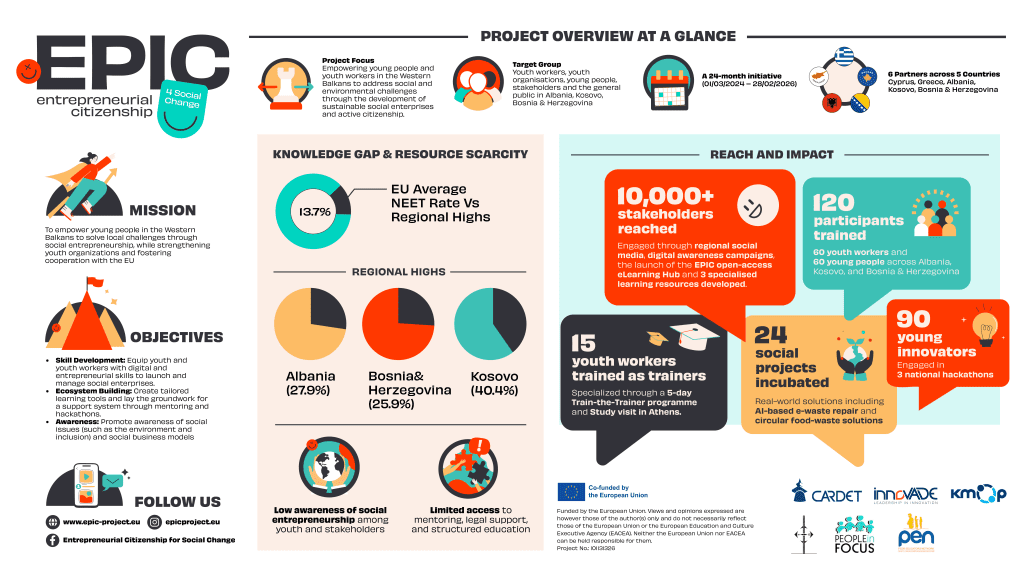
As the EPIC (Entrepreneurial Citizenship for Social Change) project officially concludes this month, it marks a significant milestone in empowering the next generation of social entrepreneurs in the Western Balkans. Supported by the European Union, the project has successfully transformed the landscape for youth organizations and young changemakers in Albania, Bosnia and Herzegovina, and Kosovo.

The EPIC project recognized the potential of young people to drive positive social transformation. By aligning with the EU’s perspective on social enterprises, the project addressed critical issues such as youth unemployment and community development. The core mission was to help youth identify social challenges and provide them with the guidance and technical skills to transform innovative ideas into sustainable businesses.

A cornerstone of the EPIC project was the creation of a robust suite of educational materials designed to bridge the gap between social intent and entrepreneurial action. These resources were methodically developed, piloted, and refined across Albania, Bosnia and Herzegovina, and Kosovo to ensure they met the specific needs of the Western Balkans.

  • The EPIC Training Curriculum on Social Entrepreneurship: This foundational curriculum provides a comprehensive framework for strengthening the entrepreneurial capacities of youth. It covers six core modules—ranging from an introduction to social entrepreneurship to financial sustainability and social value measurement—equipping participants with a complete mindset and skill set for impact-driven action.
  • Toolkit for Youth Workers: Designed for educators, professionals, and youth organization representatives, this resource offers practical guidelines and strategies to effectively mentor and counsel aspiring social entrepreneurs.
  • Toolkit for Youth: This hands-on resource provides young people with step-by-step guidance for designing, developing, and managing their own social ventures, transforming abstract ideas into actionable business models.

In addition, throughout its journey, the EPIC project delivered a series of high-impact activities:

  • In May 2025, a dynamic workshop and study visit were held in Athens, Greece, bringing together 15 youth workers from Albania, Bosnia & Herzegovina, and Kosovo. This session equipped them with the necessary skills and methodologies to transfer their knowledge back to their local communities.
  • To validate these resources, a series of pilot workshops and local training sessions were conducted, directly engaging 60 youth workers and 60 young people. These sessions translated the EPIC Curriculum and the EPIC Toolkits into practice, ensuring the materials were relevant to the specific social and economic contexts of the Western Balkans.
  • The project culminated in three regional Hackathons held between December 2025 and January 2026, engaging 90 young innovators. These events served as incubators for 24 teams, producing diverse projects ranging from AI-driven e-waste repair to circular economy models for food waste.

The project successfully cultivated a culture of innovation, with many participants reporting increased confidence and technical competence in design thinking, budgeting, and pitching. One of the most significant achievements was shifting the regional perception of social entrepreneurship from simple philanthropy to a viable, sustainable business model.

The EPIC project is committed to ensuring its legacy continues beyond its official end date. All educational materials, including the EPIC Training Curriculum, the Toolkit for Youth Workers, and the Toolkit for Youth, are now available as open-access resources.

Young people, aspiring entrepreneurs, youth workers, trainers and educators, as well as other stakeholders, can freely access these tools to continue driving social change in their communities.

Discover the full suite of resources on the official EPIC website: https://epic-project.eu/

EUPP5 Study Visit: Strengthening Civil Society Voices in Brussels

From 2-4 February, CARDET coordinated a dynamic Study Visit to Brussels under the EUPP5 project, bringing together representatives of Cypriot Civil Society Organisations for three intensive days of learning, dialogue, and networking at the heart of EU decision-making.

The visit included meetings and exchanges with European NGOs, EU institutions, and EU officials, offering participants first-hand insight into EU policy processes and advocacy pathways.

🔹 Participants engaged directly with EU policymakers, European CSOs, and institutional actors.

🔹 Beyond institutional learning, the study visit created real opportunities for collaboration, strengthened networks between Cypriot and European CSOs, and reinforced the role of civil society in shaping European policy debates.

A big thank you to all participating organisations for their active engagement, to Mr. Michalis Hadjipantelas MEP, and to our partners for their support. This visit marks another step towards a stronger, more connected, and more influential civil society at EU level.

EPIC National Hackathons: Empowering youth through social entrepreneurship

Between December 2025 and January 2026, the EPIC project (Entrepreneurial Citizenship for Social Change) successfully concluded a series of three dynamic National Hackathons across Albania, Bosnia & Herzegovina, and Kosovo. These intensive two-day events served as incubators for innovative social business ideas designed to tackle local community challenges.

The primary mission of the hackathons was to inspire and empower young people to think and act as social entrepreneurs. Key objectives included:

  • Encouraging youth to identify pressing local social issues.
  • Equipping participants with practical skills in Design Thinking, business modeling, and pitching.
  • Developing innovative, feasible, and sustainable solutions with a measurable social impact.

    The Hackathon events were implemented in:
  • Tirana, Albania: 12-13 December 2025, hosted by People in Focus (PIF) at Europe House.
  • Sarajevo, Bosnia & Herzegovina: 20-21 December 2025, hosted by Sarajevo Meeting of Cultures (SMOC).
  • Pristina, Kosovo: 10-11 January 2026, hosted by Peer Educators Network (PEN).

    The initiative successfully engaged over 100 stakeholders across the three countries, including a total of 90 young participants, 9 youth workers/educators and approximately 19 expert mentors and jury members from various sectors like academia, ministries, and private businesses.
    Each hackathon followed a structured, hands-on programme. Day 1 of the Hackathons was for “Ideation & Foundation”. Participants engaged in workshops on social entrepreneurship basics, stakeholder mapping, and problem identification. Day 2 was for “Refinement & Pitching”. Teams worked closely with mentors to develop Business Model Canvases, plan budgets, and refine their “micro-solutions” before pitching to a professional jury.

    A total of 24 teams were formed regionally, resulting in a wide array of social enterprise concepts. Winning teams from each country were selected to receive further mentoring and the opportunity to present at the EPIC Final Conference.
  • Albania: Winner PIKA, an accessibility platform for the visually impaired.
  • Bosnia & Herzegovina: Winner Inner Peace, a holistic mental health support concept.
  • Kosovo: Equal winners RECLAIM (circular food waste model) and RE-TECH (AI-driven e-waste repair).

    Beyond skill-building, the hackathons served as a powerful catalyst for youth empowerment, effectively transforming initial self-doubt into entrepreneurial confidence. Participants achieved significant growth in core competencies, most notably in teamwork, analytical thinking, and creative problem-solving.

    Evaluations of the events reflected exceptionally high satisfaction rates across the region, with the quality of expert mentorship identified by participants as a standout feature in both Bosnia & Herzegovina and in Kosovo.

    The project concluded that while youth are highly motivated to create social change, there is a strong regional demand for ongoing incubation and mentorship beyond the initial events to help turn these prototypes into real-world sustainable businesses.

More information about the project is available at: https://epic-project.eu/

fuTOURiSME: Mapping the Sustainability Landscape for Tourism SMEs Across Europe

Under Work Package 5 of the fuTOURiSME project, all partners have completed an extensive research and compilation exercise to identify the sustainability certifications most relevant for tourism SMEs in Europe. This work covers six partner countries: Greece, Spain, Cyprus, France, Germany and Italy, and includes both internationally recognised labels and national or sectoral schemes.

Today, we are pleased to announce that the full set of materials from Task 5.1 – Research and collection of existing certifications and development of guidelines is now publicly available on the fuTOURiSME website.

These resources are designed to support tourism SMEs in understanding the certification landscape and preparing their own sustainability journey.

What has been published?

  1. Consolidated Research Report (European Synthesis)

A cross-country overview presenting:

  • a comprehensive list of 80+ certifications mapped across Europe,
  • the main trends and insights,
  • a comparative analysis of environmental, social, economic and integrated certification schemes,
  • the methodological framework used by partners.

This synthesis brings together the findings from all national research teams and establishes the foundation for the next WP5 activities.

  1. National Reports & Certification Fiches

Each partner country has produced:

  • a national executive summary, and
  • detailed fiches for each certification mapped at national level.

The fiches include information on governance, scope, indicators, audit requirements, technology, usability, sector applicability and alignment with EU or international standards.

All national documents are now accessible online for full transparency and reference.

  1. Guidelines for Tourism SMEs

To support small businesses directly, fuTOURiSME has developed practical, step-by-step guidelines tailored to SMEs that want to:

  • understand what sustainability certifications exist,
  • choose the one most suitable for their activity,
  • prepare for audits and data collection,
  • integrate sustainability practices into daily operations,
  • and communicate their achievements effectively.

These guidelines will be further complemented by the capacity-building activities and coaching sessions planned in upcoming tasks.

Why this work matters

Certification is a powerful tool for tourism SMEs. It helps them:

  • improve environmental and social performance,
  • reduce operational costs,
  • meet emerging EU sustainability requirements (CSRD, ESRS),
  • increase visibility on booking platforms and tourism channels,
  • and build credibility with travellers seeking responsible experiences.

Task 5.1 provides the essential knowledge base that will feed into the development of the Sustainable Tourism Toolkit and the Self-Assessment Tool later in the project.

Next steps in WP5

  • Development of training modules and coaching sessions for SMEs
  • Creation of the fuTOURiSME Self-Assessment Tool (Task 5.3)
  • Publication of the final Sustainable Tourism Toolkit (Month 35)

These activities will build on the research now available online.

Access the Resources

All materials are available on the fuTOURiSME website.

We invite SMEs, destinations, industry stakeholders and the broader tourism community to explore the findings.

Youth Innovators at the upcoming EPIC Final Conferenceand Hackathon

A celebration of youth-driven social innovation is set to take place at the upcoming EPIC Final Conference and Hackathon. This landmark event marks the culmination of the Entrepreneurial Citizenship for Social Change project, bringing together young social entrepreneurs, youth workers, and industry experts to showcase sustainable solutions to pressing community challenges across the Western Balkans.

The social innovation Hackathon Final
The highlight of the event will be the highly anticipated Hackathon Final. After months of intensive capacity-building using the newly developed EPIC Curriculum and Toolkits, teams of young innovators will take the stage to pitch their social business models to a panel of experts. These youth-led initiatives, deeply rooted in the European EntreComp framework, aim to tackle local social and environmental issues. The hackathon will demonstrate the participants’ journey from identifying community problems to designing actionable, sustainable ventures using tools like the Social Business Model Canvas.

Reflecting on Impact
In addition to the live pitches, the Final Conference will serve as a platform to reflect on the successful pilot implementations in Kosovo, Albania, and Bosnia and Herzegovina. Stakeholders will discuss how the initiative successfully bridged the gap between social work and entrepreneurial action, empowering dozens of youth and youth workers, even in regions lacking formal legal frameworks for social enterprises.

Key Event highlights:

  • Live pitching sessions: Young entrepreneurs present their innovative social ventures.
  • Impact panels: Expert discussions on the outcomes and future of social entrepreneurship training in the Western Balkans.
  • Networking opportunities: A collaborative space connecting youth workers, young leaders, policymakers, and potential investors.

    Join the Conference
    Stakeholders, youth workers, youth, and the public are invited to attend this dynamic event to support the next generation of socially responsible leaders and explore opportunities for cross sector collaboration.

    Event details:
  • Date: 17/02/2026
  • Time: 10:00
  • Location: HomeWork Hub, Sarajevo

More information about the project is available at: https://epic-project.eu/

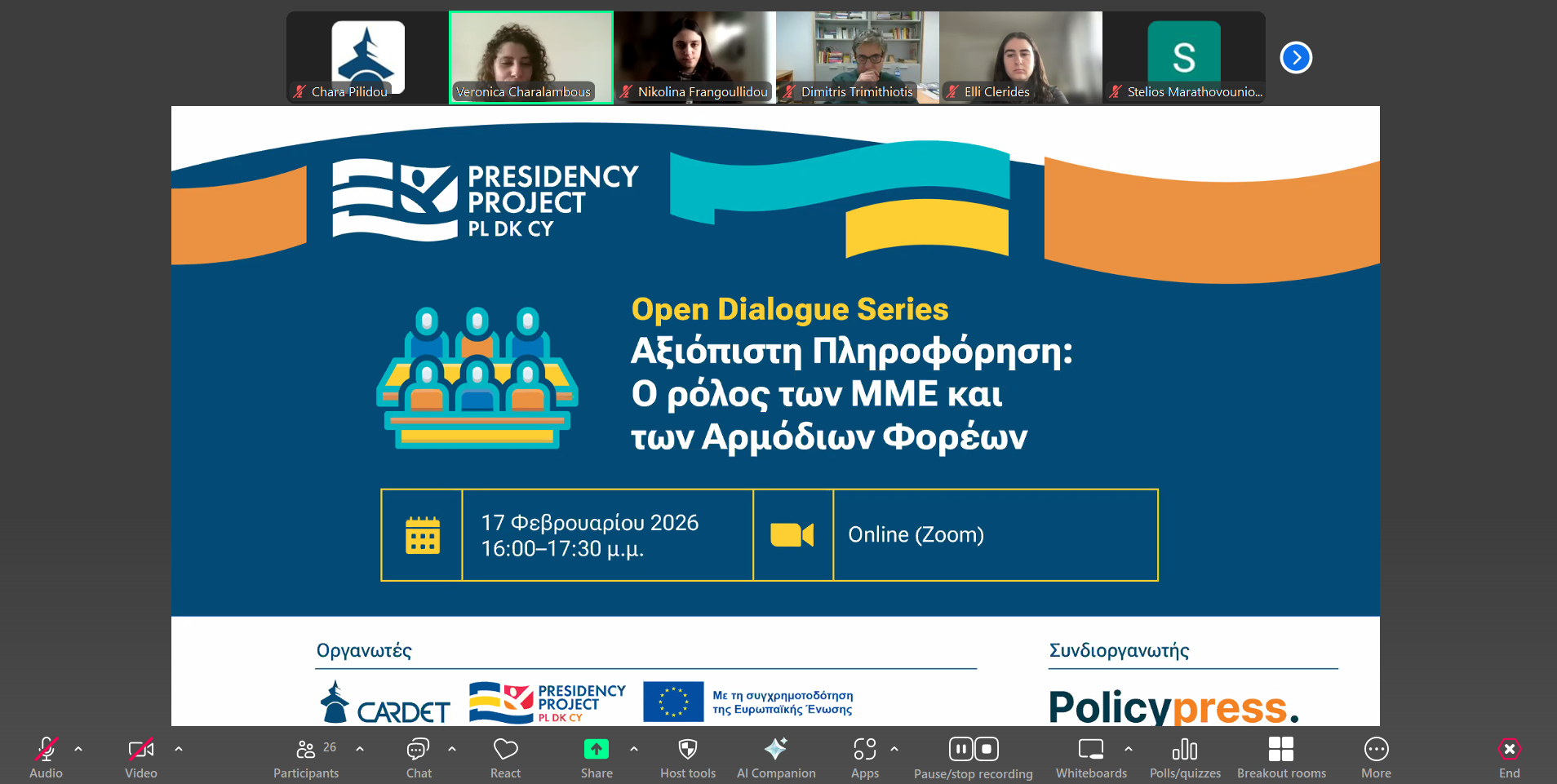
Launching the “Open Dialogue Series” on Poverty in Cyprus

The first Open Dialogue Series event was successfully held, fostering open and constructive discussion on poverty in Cyprus and its contemporary challenges. Organised within the framework of the EU Presidency Project 5 (EUPP5) and implemented by CARDET, the dialogue brought together institutional and civil society representatives to exchange perspectives and contribute to a more inclusive and socially just society.


Ο πρώτος Δημόσιος Διάλογος της σειράς “Open Dialogue Series” πραγματοποιήθηκε με επιτυχία, ανοίγοντας μια ουσιαστική συζήτηση για ένα καίριο κοινωνικό ζήτημα: τη φτώχεια στην Κύπρο και τις σύγχρονες προκλήσεις της.

Στο πλαίσιο του ευρωπαϊκού έργου EU Presidency Project 5 (EUPP5), που υλοποιείται από το CARDET, εκπρόσωποι θεσμών και της κοινωνίας των πολιτών αντάλλαξαν απόψεις, εμπειρίες και προβληματισμούς, συμβάλλοντας σε έναν ανοιχτό και γόνιμο διάλογο.

Θερμές ευχαριστίες στους ομιλητές μας:

🔹 κα Ελένη Καραολή, Πρόεδρος του Εθνικού Δικτύου Καταπολέμησης της Φτώχειας και του Κοινωνικού Αποκλεισμού Κύπρου

🔹 κ. Μάριο Αργυρού, Γενικός Γραμματέας Κυπριακού Ερυθρού Σταυρού

🔹 κ. Χρίστο Διομήδους, Λειτουργός Υπηρεσίας Διαχείρισης Επιδομάτων, Υφυπουργείο Κοινωνικής Πρόνοιας – Κυπριακή Δημοκρατία

🔹Συντονιστής: Νικόλας Αθηνής, Συντονιστής Ομάδας Νεολαίας, Δικαιωμάτων και Συμπερίληψης, CARDET

καθώς και σε όλους/όλες όσοι/όσες παρευρέθηκαν και συμμετείχαν ενεργά. Μαζί συνεχίζουμε να ανοίγουμε τον διάλογο για μια πιο δίκαιη και συμπεριληπτική κοινωνία.

Closing Event of the “Supporting Mental Health Resilience among Youth in Cyprus” Project Highlights Progress in Strengthening Youth Mental Health Resilience

The Closing Event of the project “Supporting Mental Health Resilience among Youth in Cyprus” took place on Wednesday, 28 January 2026, at CARDET’s premises in Nicosia, marking the successful completion of a 26-month EU-funded initiative. The event brought together representatives of the European Commission, UNICEF, national and local authorities, youth organisations, professionals, and young people to reflect on the project’s outcomes and future perspectives.

Implemented with the technical support of the European Commission (SG REFORM), UNICEF, and the Ministry of Health in Cyprus, and in close cooperation with national stakeholders such as the Cyprus Youth Council, the Youth Board of Cyprus, CARDET, the Municipality of Lakatamia, and the Municipality of Kourion, the project aimed to strengthen youth mental health promotion and prevention, while enhancing meaningful youth participation in policymaking in Cyprus.

Addressing participants, Mrs Maria Evangelou, Officer of Nursing Services, on behalf of Mr Evagoras Tampouris, Director of Nursing Services at the Ministry of Health, reflected on the project’s long-term relevance, stating: “Although the project is coming to an end, its impact remains alive, offering practical tools and approaches that will continue to strengthen the mental resilience of young people in Cyprus”.

In a video-recorded message, Mrs Judith Rozsa, Director at SG REFORM of the European Commission, highlighted the project’s European significance: “This project is a prime example of how EU funding can support Member States in building capacity across sectors to address healthy lifestyles and prevent mental health problems among youth and children”.

From UNICEF’s perspective, Mrs Aida Ailarova, Adolescent Development Specialist, UNICEF Europe and Central Asia, representing Mr Octavian Bivol, Deputy Director of UNICEF Europe and Central Asia, emphasised the importance of sustainability and cross-sectoral collaboration, noting: “Youth mental health is fundamental for resilient and sustainable societies. This project has highlighted the importance of cross-sector collaboration and meaningful youth participation, laying strong foundations for long-term, sustainable interventions in Cyprus”.

Representing the Youth Board of Cyprus (ONEK), Mrs Glykeria Kalamata, on behalf of Mrs Maria Miltiadou, Deputy Executive Director, underscored the central role of young people throughout the project’s implementation, stating: “Through this project, young people were given a voice to shape mental health services and contribute meaningfully to the National Youth Strategy”.

Project Achievements and Youth Engagement

During the session “Project Achievements and Journey – Key Outcomes, Milestones, and Impact Highlights”, Dr Charalambos Vrasidas, Executive Director of CARDET, presented the project’s main achievements, including participatory research processes, youth-informed policy tools, and strengthened multi-stakeholder cooperation.

“CARDET, working closely with all partners, actively supported the design and implementation of participatory processes that placed young people at the center. This project demonstrates that research, innovation, and community engagement can lead to tangible and actionable policy changes”.

This was followed by a panel discussion titled “Youth Voices: Experiences and Perspectives”, featuring contributions from Maria Diplarou, President of the Cyprus Youth Council; Maria Peyioti, Psychiatry Resident and Chair of the Health Committee of the 6th Youth Parliament (2023–2024) and Andreas Panayiotou, Podcaster and project workshop participant. Moderated by Nikolas Athinis, Youth, Rights, and Inclusion Team Leader at CARDET, the discussion highlighted lived experiences, stigma reduction, and the need for accessible, youth-friendly mental health services.

A Firechat session titled “Youth & Municipalities: Young People Ask, Municipalities Reply!” followed, with the participation of Michalis Xypsitis, Deputy Mayor of Tseri (representing the Municipality of Lakatamia), and Valentina Michael, Chief Executive Secretary of the Municipality of Kourion. Moderated by Andreas Panayiotou, the session facilitated direct dialogue between young people and local authorities.

Closing Remarks and Future Outlook

Mrs Anahit Minassian, Youth Mental Health Technical Support Coordinator at UNICEF Europe and Central Asia, outlined key outcomes achieved in Cyprus, including the adoption of a National Mental Health Strategy developed in close cooperation with young people, the prioritisation of mental health within the National Youth Strategy 2030, the introduction of a dedicated budget line for youth engagement, and the launch of the first National Campaign on Youth Mental Health. As she noted, “This initiative demonstrates how meaningful youth participation can translate into lasting policy and systemic change”.

Mr Alexandros Tifas, Mental Health Nursing Officer at the Ministry of Health, highlighted the human-centred nature of the initiative, stating: “This was not just a project of deliverables, but a shared journey that brought us closer to the real needs of young people”.

On behalf of the European Commission, Ms Hana Lucić, Policy Officer at SG REFORM, expressed her warm regards to all partners and remarked: “The commitment and collaboration demonstrated serve as an excellent example of how reform initiatives can achieve real social impact”.

The Closing Event of the “Supporting Mental Health Resilience among Youth in Cyprus” project reaffirmed the shared commitment of all stakeholders to ensure that youth mental health remains a policy priority, embedded sustainably across health, social, educational, and community systems in Cyprus.

Learn more about the project and find available the report: https://cardet.org/projects/supporting-mental-health-resilience-among-youth-in-cyprus/