Month: February 2026

AI Literacy Project Officially Launched in Nicosia

CARDET Hosts the First Transnational Partner Meeting of the Erasmus+ Teacher Academy for AI Literacy

On 26–27 February 2026, CARDET and the University of Nicosia (UNIC) proudly hosted the first Transnational Partner Meeting (TPM) of the Teacher Academy for AI Literacy (AI Literacy) project in Nicosia, Cyprus.

Funded under the Erasmus+ Teacher Academies programme (Project Ref. 101249404), the initiative establishes a transnational Teacher Academy dedicated to strengthening teachers’ competences in Artificial Intelligence literacy across Europe.

The two-day strategic meeting brought together partners from seven European countries to align on implementation, quality assurance, and long-term sustainability of the Academy. The meeting concluded with a structured review session, ensuring alignment on milestones and next steps.

AI Literacy aims to:

  • Develop a validated Teachers’ AI Literacy Competence Framework
  • Create two innovative curricula (pre-service & in-service)
  • Deliver four blended pilot courses and two summer schools
  • Train over 2,500 teachers
  • Reach more than 2,400 students
  • Achieve measurable improvements in AI confidence and responsible usage

The project addresses the urgent need for structured AI education aligned with:

  • EU digital competence frameworks
  • AI governance and ethics principles
  • GDPR and data protection standards

AI Literacy project is designed to establish a sustainable European learning community that will continue supporting teachers beyond the project lifecycle. The next phase focuses on finalising the Teachers’ AI Literacy Competence Framework (M6 milestone) and initiating curriculum development and QA structures.

Stay tuned for updates as we build Europe’s Teacher Academy for AI Literacy.

The Critical Role of Mental Health First Aid

On 13 January 2026, CARDET hosted the launch of a comprehensive Mental Health First Aid and Support training programme, delivered in multiple phases. Thirty participants took part, including healthcare professionals, educators, youth workers, and counsellors. This initiative was not merely another professional development activity; it prompted a deeper reflection: How prepared are we, as adults and as a society, to recognise and support the mental health of young people?

In everyday life, we encounter moments of uncertainty. When a young person or someone close to us begins to withdraw, when concerning signs emerge that are not easily interpreted, and when we are unsure whether or how to act or intervene, difficult questions arise: Was my response appropriate? Did I overlook a warning sign? Do I have the right to ask or become involved?

The need for structured systems, the use of a common language, and practical skills to address the growing youth mental health crisis is now indisputable. Training parents, educators, youth workers, and psychologists in these competencies is essential.

Global data reinforce the urgency of such training. According to the World Health Organization, one in seven adolescents aged 10–19 lives with a mental health condition. This is not an isolated phenomenon, but a widespread reality. Yet nearly two-thirds of young people experiencing mental health challenges do not seek support, primarily due to stigma and discrimination.

The training programme aims to equip those working with young people to act as mental health first aiders. Its core framework is based on the internationally recognised ALGEE Action Plan, which consists of five distinct steps:

A – Approach, assess, and assist: The first, and often most challenging, step involves recognising potential warning signs and initiating a supportive, informal conversation: “I have noticed you have seemed quieter lately. How are you doing?”

L – Listen non-judgmentally: This step emphasises that listening is not about immediately “fixing” the problem. It involves active listening techniques, including the use of silence and reflection, while avoiding dismissive statements such as “Others have it worse” or “Don’t think about it so much”.

G – Give support and information: Providing reassurance helps reduce feelings of isolation, conveying clearly that “You are not alone”, without offering unrealistic assurances such as “Everything will be fine tomorrow”.

E – Encourage appropriate professional help: This stage highlights the importance of collaboration with qualified professionals. An educator does not treat depression but should know how to connect a young person with an appropriate and accredited healthcare professional.

E – Encourage self-help and other support strategies: The final step focuses on empowering young people to regain a sense of control through small, manageable actions and daily habits, such as exercise, listening to music, or connecting with friends.

A central component of the training is the dismantling of pervasive myths that often paralyse adults and silence young people. Misconceptions such as “mental illness is a sign of weakness” or the belief that asking about suicide “plants the idea” are addressed through evidence-based guidance. The programme underscores that mental health exists on a continuum affecting everyone and is shaped by biological, social, and environmental factors, not by character flaws. It also addresses the three forms of stigma: public stigma (societal attitudes), self-stigma (internalised shame), and structural stigma (systemic barriers to care).

Participants learn that safety must always be the primary priority. Importantly, the training programme recognises that no single professional can carry the full responsibility for youth mental health. The role of educators, parents, and youth workers in fostering safe environments is presented as equally critical to the role of psychologists in delivering treatment. Clear and structured referral protocols are emphasised, ensuring that professionals understand whom to notify, involve, and at which stage. Effective support depends on the consistent and uninterrupted application of the process outlined above, guaranteeing that young people receive appropriate assistance at every step.

Finally, meaningful discussions on youth support must also acknowledge the psychological impact on caregivers and professionals themselves. The training introduces the concepts of compassion fatigue (emotional exhaustion resulting from prolonged caregiving) and secondary traumatic stress (internalisation of others’ trauma).

The message is unequivocal: self-care is not a luxury or an act of self-interest, but a professional necessity. Recognising signs of burnout, such as physical exhaustion or emotional detachment, constitutes an organisation’s first line of defence. Establishing boundaries and applying stress-management strategies enable care providers to maintain balance between their professional responsibilities and personal well-being.

Mental Health First Aid extends beyond a set of skills. It represents a shift from a culture of silence to one of active support. By training educators, youth workers, psychologists, and parents within a shared framework, a genuine safety net is created. It ensures that when a young person ultimately finds the courage to say, “I’ m not okay”, someone will be ready to listen, respond, and a system will be prepared to provide support.

The training programme was developed and implemented by CARDET within the framework of the “Supporting Mental Health and Care for the Well-Being of Vulnerable Children and Youth” project. The project is funded by the European Union through the Technical Support Instrument and implemented by UNICEF in cooperation with the European Commission. It is carried out in collaboration with the Ministry of Health of the Republic of Cyprus, with CARDET coordinating and delivering relevant actions supported by the Cyprus Youth Council and the Youth Board of Cyprus.

Dr Charalambos Vrasidas
Founder and Executive Director, CARDET
Professor, University of Nicosia


About the Project

The project Supporting Mental Health Resilience among Youth in Cyprus is funded by the European Commission via the Technical Support Instrument (TSI) and implemented by UNICEF in collaboration with the Ministry of Health of Cyprus. CARDET coordinates the research component with the support of the Youth Board of Cyprus (ONEK) and the Cyprus Youth Council (CYC). Project Reference: ECARO/PCA202294/SPD2024252

“The Empty Chair”: Reclaiming Democratic Space for Cypriot Youth

When Cyprus assumed the Presidency of the Council of the European Union in 2026 under the motto “An Autonomous Union. Open to the World”, it projected resilience outward. Yet at home, one chair in its democracy remains conspicuously empty: the one reserved for its youth. Taking office during a time of severe geopolitical upheaval, this presidency seeks to turn these difficulties into chances for social cohesion and resilience (Secretariat of the Cyprus Presidency, 2025). Beneath the high-level summits, though, there is still a significant domestic issue: the growing distance between young Cypriots and the official democratic processes.

Cyprus presents a democratic paradox: young people vote, volunteer and mobilise, yet they rarely govern. The country recorded one of the lowest numbers of youth active in societal change initiatives at 31%, significantly trailing the EU average of 48% (‘Youth and Democracy’ survey showed; Kountouris, 2011). This lack of trust in political institutions is reflected in political representation; despite making up a significant portion of the workforce, only 9% of the national parliament is under the age of 35 (YouthWiki, 2025a). While the results of the 4th Youth Barometer, show 61% of young people aged 18-35 report they ‘usually tend to vote,’ official data shows that in recent elections, young people were rarely found as political representatives, with no reserved seat quotas or existing provisions to facilitate their candidacy (YouthWiki, 2025a).

Labeling this trend as ‘youth apathy’ obscures a deeper institutional failure: participation structures have not evolved at the pace of economic and social pressures facing young citizens. As of late 2025, youth unemployment in Cyprus stood at 13.1%, which, while improving, remains a central concern for graduates entering the market (YCharts, 2025). Furthermore, skyrocketing costs mean young people increasingly struggle to leave the parental home, despite state housing aid approaching €80 million. These everyday pressures, including energy costs and protection in the digital environment, create a ‘locked out’ generation where the ‘empty chair’ at the policy table is often a result of being too exhausted by survival to participate in governance.

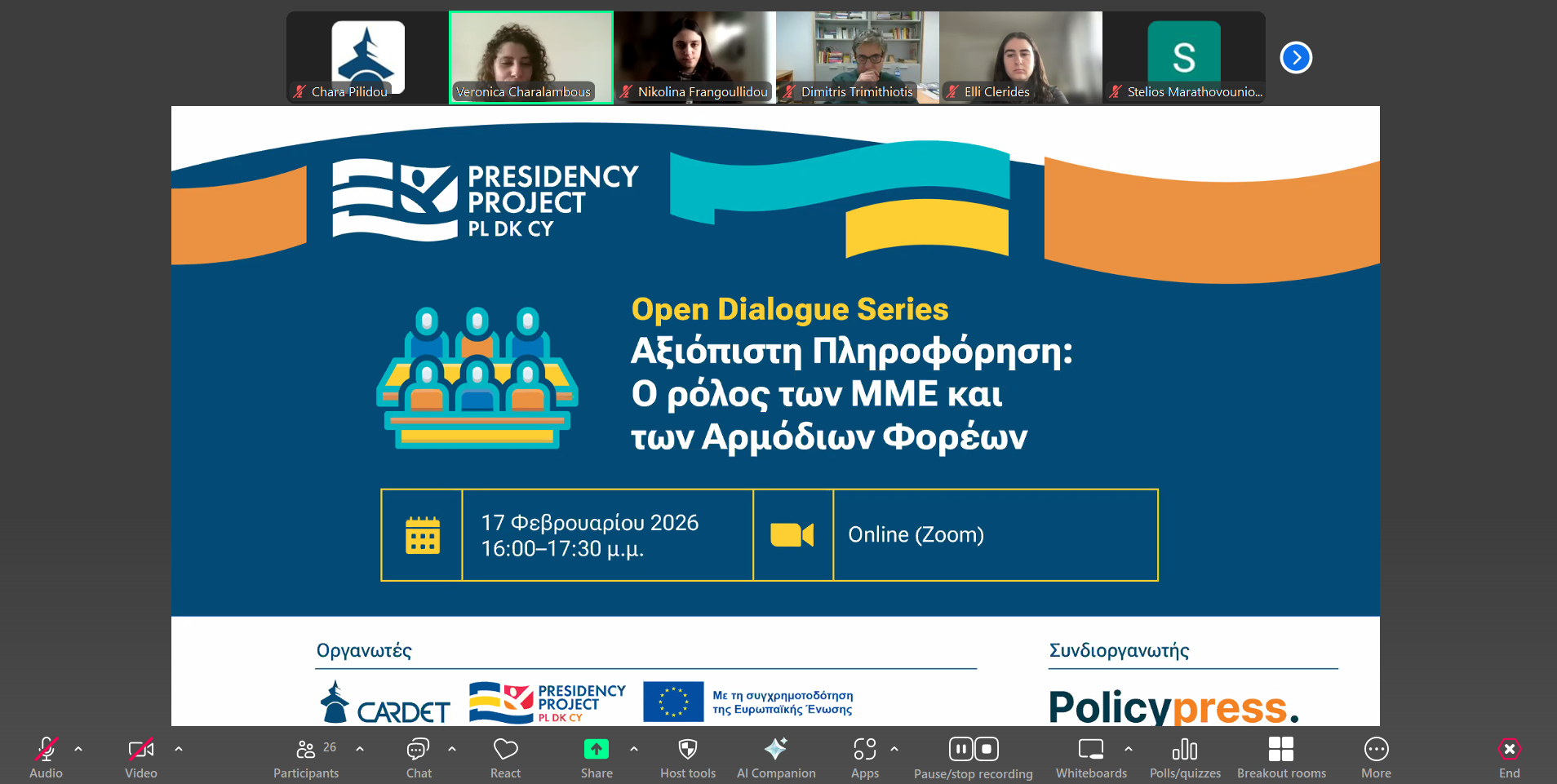
If disengagement is structural, then symbolic inclusion will not suffice. Structural reform must follow. The 2026 Presidency offers a chance to advocate for systemic changes in addition to being a logistical exercise. An important initiative in this landscape is the EU Presidency Project 5 (EUPP5), funded by the European Commission and coordinated in Cyprus by CARDET. Through EUPP5, civil society is already laying the groundwork for a more inclusive future by facilitating dialogue between policymakers and citizens on themes like civic space and the just transition (CARDET, 2026). To move from despising politics to shaping policy, we must focus on three transformative pillars.

First, we must modernise the gateway to democracy. The 2025 constitutional amendment to lower the voting age to 17—along with automatic voter registration—is a significant step, though it will not take effect until July 2027 (YouthWiki, 2025a). In order to create lifelong engagement habits, we must use the 2026 Presidency as a ‘bridge year’ to engage the newly eligible voters through extensive civic education campaigns.

Second, there must be a formal recognition of non-formal learning. In order to bridge the gap between formal resumes and social engagement, grassroots activism and involvement in youth projects funded by the EU should be considered “civic credits”. Programmes such as Erasmus+ and the European Solidarity Corps already function as laboratories of democratic practice. Young people develop negotiation skills, media literacy and policy awareness through transnational engagement. Yet these experiences rarely translate into formal political pathways at home. Recognising non-formal civic participation as institutional capital would bridge that gap. The Foundation for the Management of European Lifelong Learning Programmes (IDEP) in Cyprus will play a key role in highlighting these pathways as lifelines for democratic engagement.

Cyprus could institutionalise intergenerational accountability by introducing a mandatory ‘Youth Impact Assessment’ for all Presidency-linked policy proposals, ensuring measurable evaluation of long-term effects on citizens under 35. This converts young people from passive recipients of policy into active participants in the European landscape by ensuring that every piece of legislation, from digital rights to green transitions, is evaluated for its long-term effects on the next generation.

The motto of an Autonomous Union must apply to our youth as well; we cannot claim to be an open or an autonomous Union if our youngest citizens feel locked out of the room. The empty chair is not evidence of youth indifference; it is evidence of institutional design failure. If Cyprus truly seeks resilience and cohesion, widening the pathways to democratic power must become part of its Presidency legacy, not a side conversation to it.

The project “Towards an open, fair and sustainable Europe in the world – EU Presidency Project 2024-2026” is  co-funded  by the European Union and implemented by Global Focus, Grupa Zagranica, CARDET, and CONCORD, the European Confederation of NGOs working on sustainable development and international cooperation. Project Number: 2024 / 459-484. The contents of this publication are the sole responsibility of CARDET and do not necessarily reflect the views of the European Union.  

Katerina Panayi,
CARDET Researcher and Project Manager

Τhis opinion piece was published on Policypress.

References

Final EPIC Project Conference Held in Sarajevo Highlights Transformative Impact on Social Entrepreneurship

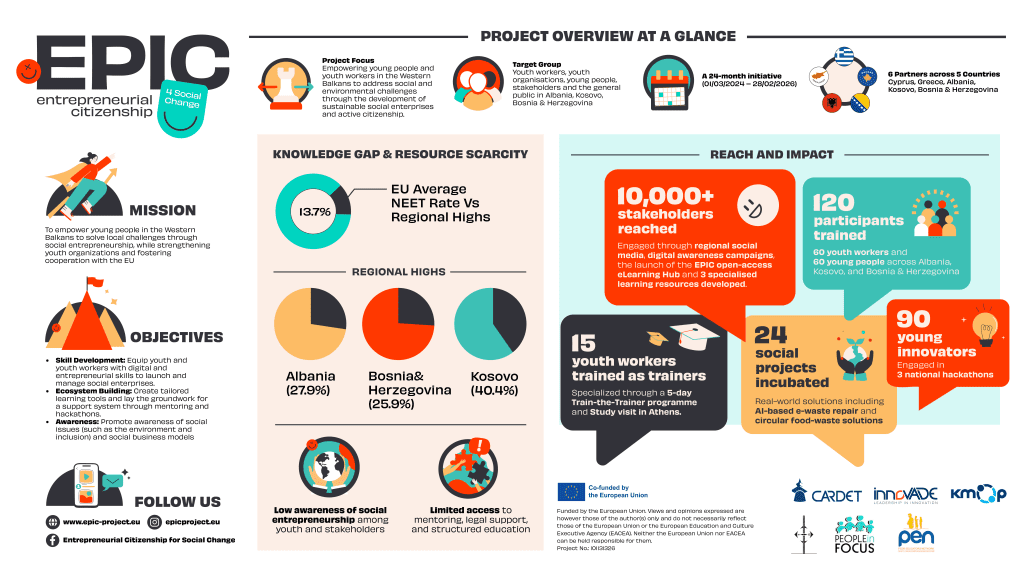
The Final Conference and Meeting of the EPIC project took place in Sarajevo on February 17 2026, bringing together stakeholders, partners, youth workers, and young innovators to reflect on the project’s achievements and long-term contribution to social entrepreneurship across the Western Balkans. The event was hosted by SMOC, with the support of CARDET.

The conference featured presentations of the project’s core outputs, key results, and practical tools developed throughout the initiative, alongside keynote speeches exploring the evolving landscape, opportunities, and potential of social entrepreneurship. Participants also had the opportunity to engage with the winning teams of the National Hackathons, whose projects demonstrated creativity, technical competence, and strong potential for sustainable social impact.

Over the course of its implementation, the EPIC project has delivered substantial outcomes that strengthen the social innovation ecosystem in Albania, Bosnia & Herzegovina, and Kosovo. Among its principal achievements, the project developed the EPIC Training Curriculum on social entrepreneurship, structured around six comprehensive modules designed to support capacity-building and skills development. Complementary Toolkits for Youth Workers and Toolkits for Youth were also created to provide practical guidance for aspiring social entrepreneurs and those supporting them.

In addition, the project facilitated a targeted workshop and study visit in Athens, equipping youth workers with enhanced mentoring and facilitation competencies. Pilot workshops further engaged youth workers and young people, enabling the testing and refinement of project resources in real-world contexts. A series of three regional hackathons incubated innovative concepts addressing pressing social and environmental challenges, ranging from technology-driven solutions to circular economy models.

Beyond tangible outputs, EPIC has contributed to a notable shift in how social entrepreneurship is perceived, emphasizing its role as a viable and sustainable model rather than solely a philanthropic endeavor. The initiative has supported the cultivation of entrepreneurial mindsets, confidence, and applied skills in areas such as design thinking, budgeting, and pitching.

All EPIC resources are now openly accessible, ensuring that youth organizations, trainers, and young changemakers can continue to benefit from and build upon the project’s legacy.

Further information and access to project materials are available at: https://epic-project.eu/ 

job position we are hiring CARDET

Head of Program Implementation

CARDET is one of the leading research and development centres in Cyprus and the region, dedicated to promoting social impact, innovation, and lifelong learning. At CARDET, we envision a just and sustainable world where people learn and flourish. Our mission is to design innovative education and services that inspire and empower individuals and communities to thrive. We believe that education can be a powerful force for change— addressing global challenges by equipping people with the knowledge, skills, and values to build a better future. If you want to have an impact and are interested in working for a purpose-driven organisation, we would like to hear from you.

  • Lead the full portfolio of EU-funded, commercial, and tender-based projects, ensuring excellence in delivery, financial discipline, regulatory compliance, and measurable impact.
  • Own and continuously strengthen the Project Implementation Framework, standards, tools, and methodologies to ensure consistency, scalability, and high-quality delivery across projects.
  • Define and monitor portfolio KPIs covering delivery, budget performance (in coordination with Finance), quality, stakeholder engagement, and impact, ensuring timely corrective action where needed.
  • Provide direct leadership to the Project Management & Research Coordinators, setting performance expectations, allocating resources, and ensuring high standards of accountability, collaboration, and delivery.
  • Hold accountability for portfolio-level budget monitoring, financial compliance coordination, forecasting, and risk mitigation in alignment with EU regulations and internal controls, in close collaboration with the Finance function.
  • Oversee quality assurance processes are consistently applied, ensuring adherence to funder and client requirements and strengthening audit readiness and compliance standards in collaboration with Finance and project teams.
  • Ensure strong cross-departmental coordination with Business Development, Research, Marketing/Communications, Finance, and People & Culture to guarantee operational feasibility and continuity from proposal to delivery.
  • Identify and manage operational , financial, and delivery risks across the portfolio , escalating critical issues to the Executive Director and proposing structured mitigation actions.
  • Represent the organisation in partner and consortium meetings related to project implementation, delivery performance, and operational coordination.
  • Drive continuous improvement, digital adoption, and data-informed decision-making across the implementation portfolio to enhance efficiency, quality, and impact.
  • Master’s degree in education, social sciences, digital learning, psychology, health, business, sustainability, or related field.
  • PhD is an asset.
  • Professional certification in Project Management (PMP, PRINCE2, or equivalent) preferred.
  • Significant experience in EU-funded project management, demonstrating progressive responsibility in multi-partner or complex projects.
  • Proven experience leading multi-project portfolios.
  • Demonstrated leadership and team management experience.
  • Experience managing high-value and complex consortia.
  • Advanced knowledge of EU regulations (Erasmus+, Horizon, etc.).
  • Strong leadership presence and decision-making capability.
  • Strategic planning and systems thinking.
  • Strong financial governance capability.
  • Risk management expertise.
  • High-level stakeholder management and negotiation skills.
  • High analytical capability and performance orientation.
  • Cross-functional alignment between Project Management, Research, and Finance functions
  • (measured by reduction in delivery bottlenecks and escalation frequency).
  • Excellent written and verbal communication (Greek & English).
  • Inclusive, wellbeing-oriented, and family-friendly culture
  • 13th Salary and Provident Fund
  • Extended annual leave designed to promote rest and wellbeing
  • Fully paid maternity/paternity leave
  • Lifelong learning and professional development opportunities
  • Flexible hybrid work and shorter Fridays
  • Candidates are invited to complete the online application form and submit an up-to-date CV and cover letter by 10th March 2026, through the following link.
  • Shortlisted candidates will be asked to:
    • Complete a self-declaration form confirming they have not been subject to disciplinary, administrative, or criminal sanctions.
    • Submit two professional references and a valid clear criminal record certificate issued by the Cyprus Police at the final stage of the selection process and prior to appointment.
    • Submit samples of previous work upon request.

The position will remain open until filled. All applications will be treated in strict confidence and evaluated fairly.

Due to the large number of applications we receive, only shortlisted applicants will be contacted.

CARDET is an HR Award-winning, equal opportunities, and disability-confident employer of choice. The organization has been accredited with the Sound Industrial Relations 2014 Standard and is fully committed to promoting, safeguarding and preventing all forms of sexual abuse and exploitation.

CARDET complies with GDPR. For more details, visit www.cardet.org/privacy-policy .
For questions, contact 22 002100.

CARDET job opening

Coordinator of Project Management

CARDET is the largest independent research and development organisation in Cyprus with a strong presence in Europe and the region. At CARDET we envision a just and sustainable world where people learn and flourish. Our mission is to design innovative education and services that inspire and empower individuals and communities to thrive. We believe that education can be a powerful force for change. A large part of global problems and challenges are a result of the lack of knowledge, skill, and competencies. Our approach to education aims to have a strong social impact and help shape a better world through education, training, capacity building, awareness raising, and communication.

If you want to have an impact and are interested in working for a purpose-driven organisation, we would like to hear from you. As we expand our teams new opportunities are opening-including the following role:

  • Coordinate and oversee portfolio by monitoring project timelines, milestones, risks and reporting schedules across teams, ensuring consistent execution standards and effective use of project management tools.
  • Review project action plans and provide feedback to Project Managers.
  • Manage directly assigned projects across the full lifecycle.
  • Conduct internal reviews of key deliverables before submission to Head of Project Implementation and support audit and evaluation readiness.
  • Ensure alignment with EU regulations, client requirements, internal policies, documentation protocols and reporting timelines.
  • Identify cross-project risks, resource constraints, or compliance gaps and escalate appropriately.
  • Provide guidance to the team, onboarding support and performance input.
  • Collaborate closely with Finance, Marketing/Communications, Research, Technology, and Business
  • Development teams to ensure alignment and operational effectiveness.
  • Provide updates to the Head of Project Implementation, escalate high-risk issues and contribute to internal reporting dashboards and performance reviews.
  • Bachelor’s degree in a relevant field.
  • Master’s degree in education, social sciences, engineering, computer science, digital learning, psychology, health, sustainability, or a related field.
  • Professional certification in Project Management (PMP, PRINCE2, or equivalent) is an asset.
  • Demonstrated experience in EU-funded project management, with evidence of progressively responsible roles in complex or multi-partner projects.
  • Demonstrated experience managing projects end-to-end.
  • Experience supporting or guiding other Project Managers is desirable.
  • Strong knowledge of EU programme regulations (e.g., Erasmus+, Horizon).
  • Advanced planning and coordination skills.
  • Budget monitoring and financial literacy.
  • Risk management capability.
  • Strong stakeholder management skills.
  • Excellent written and verbal communication in Greek and English.
  • High level of organisational awareness and accountability.
  • Ability to operate with autonomy within defined strategic direction
  • Inclusive, wellbeing-oriented, and family-friendly culture
  • 13th Salary and Provident Fund
  • Extended annual leave designed to promote rest and wellbeing
  • Fully paid maternity/paternity leave
  • Lifelong learning and professional development opportunities
  • Flexible hybrid work and shorter Fridays
  • Candidates are invited to complete the online application form and submit an up-to-date CV and cover letter by 10th March 2026, through the following link.
  • Shortlisted candidates will be asked to:
    • Complete a self-declaration form confirming they have not been subject to disciplinary, administrative, or criminal sanctions.
    • Submit two professional references and a valid clear criminal record certificate issued by the Cyprus Police at the final stage of the selection process and prior to appointment.
    • Submit samples of previous work upon request.

The position will remain open until filled. All applications will be treated in strict confidence and evaluated fairly.

Due to the large number of applications we receive, only shortlisted applicants will be contacted.

CARDET is an HR Award-winning, equal opportunities, and disability-confident employer of choice. The organization has been accredited with the Sound Industrial Relations 2014 Standard and is fully committed to promoting, safeguarding and preventing all forms of sexual abuse and exploitation.

CARDET complies with GDPR. For more details, visit www.cardet.org/privacy-policy .
For questions, contact 22 002100.

job vacancy CARDET join our team we are hiring

Digital Marketing Executive

CARDET is the largest independent research and development organisation in Cyprus with a strong presence in Europe and the region. At CARDET we envision a just and sustainable world where people learn and flourish. Our mission is to design innovative education and services that inspire and empower individuals and communities to thrive. We believe that education can be a powerful force for change. A large part of global problems and challenges are a result of the lack of knowledge, skill, and competencies. Our approach to education aims to have a strong social impact and help shape a better world through education, training, capacity building, awareness raising, and communication.

If you want to have an impact and are interested in working for a purpose-driven organisation, we would like to hear from you. As we expand our teams new opportunities are opening-including the following role:

  • Manage and grow CARDET’s digital platforms (LinkedIn, Facebook, Instagram, X, YouTube, TikTok), ensuring consistent brand presence and audience engagement.
  • Plan and execute organic and paid digital campaigns aligned with communication objectives, optimising performance through data-driven insights.
  • Develop high-quality written and visual content for websites, social media, newsletters, and campaigns, translating EU-funded project outcomes into accessible and engaging digital stories.
  • Produce and edit short-form video content for digital platforms, including concept development, scripting, filming, and post-production, ensuring alignment with brand guidelines and communication goals.
  • Monitor key digital performance indicators (reach, engagement, conversions, growth) and prepare structured performance summaries with practical optimisation recommendations.
  • Coordinate content calendars, campaign scheduling, and event promotion to ensure timely and impactful communication.
  • Support institutional campaigns and high-visibility launches, contributing to cross-department communication initiatives.
  • Contribute to improving digital workflows, reporting processes, and the responsible use of AI tools for content enhancement and efficiency.
  • Bachelor’s degree in Marketing, Communications, Digital Media, or related field
  • Demonstrated experience in digital marketing, social media management, or content creation
  • Experience with organic and paid social media campaigns (Meta, LinkedIn, Google Ads, etc.)
  • Familiarity with Google Analytics and digital performance tracking tools
  • Strong copywriting and storytelling ability
  • Proficiency in Canva or similar design tools; basic video editing skills considered an asset
  • Familiarity with AI tools for content and workflow optimisation considered an advantage
  • Excellent written communication skills in Greek and English
  • Strong organisational and campaign coordination abilities
  • Analytical mindset with attention to performance metrics
  • Proactive and solution-oriented attitude
  • Ability to manage multiple deadlines and priorities
  • Collaborative mindset and responsiveness to team needs
  • Growth-oriented approach with continuous learning mindset
  • Inclusive, wellbeing-oriented, and family-friendly culture
  • 13th Salary and Provident Fund
  • Extended annual leave designed to promote rest and wellbeing
  • Fully paid maternity/paternity leave
  • Lifelong learning and professional development opportunities
  • Flexible hybrid work and shorter Fridays
  • Candidates are invited to complete the online application form and submit an up-to-date CV and cover letter by 10th March 2026, through the following link.
  • Shortlisted candidates will be asked to:
    • Complete a self-declaration form confirming they have not been subject to disciplinary, administrative, or criminal sanctions.
    • Submit two professional references and a valid clear criminal record certificate issued by the Cyprus Police at the final stage of the selection process and prior to appointment.
    • Submit samples of previous work upon request.

The position will remain open until filled. All applications will be treated in strict confidence and evaluated fairly.

Due to the large number of applications we receive, only shortlisted applicants will be contacted.

CARDET is an HR Award-winning, equal opportunities, and disability-confident employer of choice. The organization has been accredited with the Sound Industrial Relations 2014 Standard and is fully committed to promoting, safeguarding and preventing all forms of sexual abuse and exploitation.

CARDET complies with GDPR. For more details, visit www.cardet.org/privacy-policy .
For questions, contact 22 002100.

job vacancy CARDET

Coordinator of Research

CARDET is the largest independent research and development organisation in Cyprus with a strong presence in Europe and the region. At CARDET we envision a just and sustainable world where people learn and flourish. Our mission is to design innovative education and services that inspire and empower individuals and communities to thrive. We believe that education can be a powerful force for change. A large part of global problems and challenges are a result of the lack of knowledge, skill, and competencies. Our approach to education aims to have a strong social impact and help shape a better world through education, training, capacity building, awareness raising, and communication.

If you want to have an impact and are interested in working for a purpose-driven organisation, we would like to hear from you. As we expand our teams new opportunities are opening-including the following role:

  • Work closely with the Coordinator of Project Management and the Head of Program Implementation in coordinating research activities across projects, ensuring consistency in methodologies, documentation standards and workload distribution.
  • Lead or co-lead research tasks within direct assigned projects.
  • Conduct internal pre-reviews of reports, publications, policy briefs, and training materials before submission to the Head of Program Implementation.
  • Ensure adherence to ethical standards, data protection requirements, and EU/donor quality expectations.
  • Monitor feedback received on deliverables and ensure revisions are implemented effectively.
  • Reduce recurring quality comments through structured guidance and standardisation.
  • Identify risks, quality gaps, or timeline issues and escalate where necessary.
  • Contribute thematic expertise to proposal development and support grant developers with evidence-based input and research design.
  • Support onboarding, peer guidance, and capacity building of researchers.
  • Promote structured research processes, digital tools, and workflow optimisation across teams.
  • Bachelor’s degree in a relevant field.
  • Master’s degree in education, social sciences, digital learning, psychology, health, sustainability, or related field.
  • Minimum 5 years of applied research experience.
  • Experience in EU-funded projects (e.g., Horizon Europe, Erasmus+, Policy Experiments).
  • Experience coordinating research tasks and/or supporting peers is desirable.
  • Strong understanding of qualitative and quantitative methodologies.
  • Strong knowledge of EU programme regulations (e.g., Erasmus+, Horizon).
  • High-level writing and analytical skills.
  • Strong quality assurance orientation.
  • Ability to translate research into practical outputs (training, toolkits, policy briefs).
  • Strong organisational and prioritisation skills.
  • Excellent written and verbal communication in Greek and English.
  • Ability to operate autonomously within defined strategic direction.
  • Inclusive, wellbeing-oriented, and family-friendly culture
  • 13th Salary and Provident Fund
  • Extended annual leave designed to promote rest and wellbeing
  • Fully paid maternity/paternity leave
  • Lifelong learning and professional development opportunities
  • Flexible hybrid work and shorter Fridays
  • Candidates are invited to complete the online application form and submit an up-to-date CV and cover letter by 10th March 2026, through the following link.
  • Shortlisted candidates will be required to:
    • Complete a self-declaration form confirming they have not been subject to disciplinary, administrative, or criminal sanctions.
    • Submit two professional references and a valid clear criminal record certificate issued by the Cyprus Police at the final stage of the selection process and prior to appointment.
    • Submit samples of previous research or writing work upon request.

The position will remain open until filled. All applications will be treated in strict confidence and evaluated fairly.

Due to the large number of applications we receive, only shortlisted applicants will be contacted.

CARDET is an HR Award-winning, equal opportunities, and disability-confident employer of choice. The organization has been accredited with the Sound Industrial Relations 2014 Standard and is fully committed to promoting, safeguarding and preventing all forms of sexual abuse and exploitation.

CARDET complies with GDPR. For more details, visit www.cardet.org/privacy-policy .
For questions, contact 22 002100.

VIRDUAL project the release of the third newsletter

VIRDUAL Project releases its 3rd Newsletter

VIRDUAL project is pleased to announce the release of its Newsletter #3. This edition highlights the successful completion of the first phase of piloting activities carried out between August and December 2025 in Italy, Cyprus, Germany, Greece, Spain and Türkiye. VET teachers and in-company trainers tested the VIRDUAL e-Learning Campus and Instructional Web App, exploring XR-based modules for Work-Based Learning and creating their own training content. The results demonstrate strong learning impact, high usability, and clear relevance to real workplace and vocational education needs, confirming the project’s innovative contribution to VET across Europe.

Read more in the newsletter below!

To learn more about the VIRDUAL project visit the website here!

CARDET and CCS Drive All Digital Weeks 2026 Initiatives in Cyprus, Focusing on Digital Well-being

No digital well-being without digital inclusion 

CARDET, in collaboration with the Cyprus Computer Society (CCS), has been nominated as National Coordinators for All Digital Weeks 2026 in Cyprus. Running from 9 to 25 March 2026, All Digital Weeks is one of Europe’s leading awareness-raising campaigns on digital skills for inclusion, empowerment, and employment, bringing together organisations, educators, and citizens around a shared mission to strengthen essential digital competences.

The 2026 edition, held under the theme “Digital Wellbeing for a Competitive Europe,” highlights digital wellbeing as a critical condition for meaningful participation, trust, and long-term societal resilience. As digital technologies become ever more embedded in daily life, they increasingly shape how people communicate, learn, work, and engage with public services. While digitalisation opens new opportunities, it also introduces challenges that directly affect wellbeing, safety, and inclusion.

Digital participation is not neutral. The ways in which individuals interact with technology can either empower them or deepen existing inequalities and vulnerabilities. For many people — including young individuals, older adults, and those with limited digital skills — digital environments may feel complex, overwhelming, or unsafe. In this context, healthy digital habits are not merely desirable; they are fundamental to fostering confident and inclusive digital participation.

Why Digital Well-being Matters

Healthy digital habits enable individuals to use technology in ways that support autonomy, confidence, and personal wellbeing. They include the ability to manage screen time, recognise and respond to online risks, protect personal data, and critically evaluate digital content. Without such competences, users may be more exposed to misinformation, privacy violations, online harassment, and patterns of digital engagement that undermine trust and participation.

Insights emerging from civil society organisations and educational practice consistently point to similar concerns. Many users report the negative effects of excessive screen exposure, difficulties navigating digital safety issues, and limited awareness of digital rights, including data protection and the right to data deletion. Importantly, these challenges tend to disproportionately affect those who already face barriers to digital inclusion, thereby reinforcing rather than reducing inequalities.

Digital wellbeing therefore extends beyond individual behaviour. It is closely linked to social cohesion, democratic participation, economic opportunity, and the capacity of citizens to engage confidently in digital societies. Strengthening digital wellbeing contributes not only to personal resilience but also to more inclusive and trustworthy digital ecosystems.

All Digital Weeks 2026

All Digital Weeks will officially launch on 10 March 2026 with a European event in Brussels, followed by a wide range of national and local activities coordinated across participating countries. Throughout the campaign period, events, workshops, and training initiatives will be featured on the campaign’s interactive map, showcasing diverse practices that advance digital skills and inclusion.

In Cyprus, CARDET and CCS will coordinate a series of workshops, information sessions, stakeholder meetings, and engagement activities designed to promote digital skills, foster dialogue, and strengthen awareness of digital wellbeing. These initiatives aim to support citizens, educators, professionals, and institutions in navigating the opportunities and risks of digital transformation.

Statement of All Digital CEO

“Digital skills now decide who can work, access public services, and take part in society,” says David Mekkaoui, CEO of All Digital. “For those already skilled, digital inclusion means wider user bases, shared European values and a stronger economy. For those less confident, it means access to jobs, public services, reliable information, and everyday independence. All Digital Weeks exists to close that gap, locally, practically, and for everyone”.

Get Involved!

All Digital Weeks 2026 is open to everyone, organisations, educators, policymakers, and citizens alike. To participate, organise an event, or explore learning opportunities, visit: https://all-digital.org/all-digital-weeks/

Join the conversation online using #AllDigitalWeeks #ADWeeks2026 and help us build a more inclusive digital future for all! 

About All Digital

All Digital is a leading pan-European association based in Brussels, representing member organisations across Europe that work to enhance digital skills and competences of all people, making them aware and capable to foster their employability, access and user online services and be included in today’s society, with the ultimate goal of improving their quality of life.

All Digital represents digital education stakeholders, such as digital competence centres, adult education centres, community centres, schools, libraries and their networks across Europe where young people and adults can access training and support to improve their digital skills and keep up to date with the latest technological developments, to exploit the opportunities of digital transformation.

For media inquiries, please contact:
Alexandre Oliveira
Events manager, All Digital
alexandre.almeida@all-digital.org