Month: June 2026

Shaping the Future of Digital Safety: LAYERS Transnational Partners Meeting Highlights Next Major Milestones

On the 11th of June 2026, following the successful leadership training event in Athens, partners of the LAYERS project convened for a vital Transnational Partners Meeting to harmonize their strategies, share country-specific achievements, and map out the next critical phases of their collaborative mission.

Hosted by KMOP at Piraeus Headquarters, the meeting brought together dedicated representatives from Greece, Cyprus, Albania, Bosnia and Herzegovina, Kosovo, and Montenegro, and provided a dynamic platform to share local updates and ensure that project tools are tailored seamlessly to regional realities.

The Big Highlight: Unveiling the Next-Gen Training Modules

The definitive focal point of the meeting was the strategic finalization of the upcoming capacity-building training modules designed specifically for youth workers. Building directly on the foundational concepts established in the project’s Gender Lens Analysis Handbook, these incoming modules are designed to turn theory into immediate frontline action:

  • Securing Digital Safe Spaces: Practical methodologies to secure online youth engagement environments, establish effective comment moderation guidelines, and foster inclusive digital participation.
  • Survivor-Centered Care & Confidentiality: Training youth workers to utilize non-judgmental language, clarify confidentiality boundaries, and safely handle sensitive digital abuse disclosures without causing re-traumatization.
  • Countering Emerging Tech Threats: Specialized curriculum addressing algorithmic discrimination, generative AI bias, and the weaponization of deepfakes or online smear campaigns.

Moving Forward: The Implementation Roadmap

Partners concluded the meeting by establishing a clear timeline for the localized rollouts of these modules and the upcoming online support and mentoring programs. By embedding these comprehensive frameworks into local organizational structures, the coalition is moving beyond temporary fixes to create a sustainable, self-monitoring ecosystem of digital safety.

LAYERS project aims to empower youth workers and organizations across the Western Balkans to effectively combat online gender-based violence (OGBV) by enhancing their capacities, fostering cross-border exchange of best practices, and raising awareness on this critical issue.

Get Involved and Stay Connected!

Discover our upcoming training opportunities, multimedia toolkits, and educational resources by visiting us online: https://layers-project.eu/

EUPP5 Open Dialogue on Wellbeing, Access to Care and Mental Health

Interesting discussions and diverse perspectives on wellbeing, access to care and mental health emerged during the Public Dialogue organised as part of the EUPP5 project, titled “Wellbeing: Access to Care, Digital Health and Mental Health”, held at the Cyprus Red Cross building in Nicosia. The event highlighted both the challenges and opportunities for creating a more accessible, effective and people-centred care system in Cyprus, with a strong focus on digital health and the importance of mental wellbeing.


Ενδιαφέρουσες συζητήσεις και διαφορετικές προσεγγίσεις γύρω από θέματα ευημερίας, πρόσβασης στη φροντίδα και την ψυχική υγεία ανέδειξε ο Δημόσιος Διάλογος στο πλαίσιο του προγράμματος EUPP5 με τίτλο «Ευημερία: Πρόσβαση στη Φροντίδα, Ψηφιακή Υγεία και Ψυχική Υγεία», ο οποίος πραγματοποιήθηκε σε δύο διαφορετικές ημέρες/τοποθεσίες.

Η πρώτη εκδήλωση φιλοξενήθηκε στο Κτίριο του Ερυθρού Σταυρού στη Λευκωσία, και η δεύτερη στο χωριό Φικάρδου με τη συμβολή και yoga instructor, εστιάζοντας στην πρακτική εφαρμογή της ευεξίας και φροντίδας του σώματος, καθώς και της ψυχικής υγείας.

Κατά τη διάρκεια της εκδήλωσης στον Ερυθρό Σταυρό, αναφέρθηκαν οι προκλήσεις αλλά και οι δυνατότητες που υπάρχουν για ένα πιο προσβάσιμο, αποτελεσματικό και ανθρωποκεντρικό σύστημα φροντίδας στην Κύπρο, με ιδιαίτερη έμφαση στην ψηφιακή υγεία και τη σημασία της ψυχικής ευημερίας.

Ευχαριστούμε θερμά τον Νίκο Παπαδόπουλο, Λειτουργό Ψυχοκοινωνικής Στήριξης του Κυπριακού Ερυθρού Σταυρού, και τη Μαρία Καλλή, Coordinator of Research του CARDET, για τη συμβολή τους στη συζήτηση, καθώς και όλους όσοι συμμετείχαν ενεργά με σκέψεις, εμπειρίες και εισηγήσεις.

How Europeans Consume Political Information in the Digital Age

Europe’s public sphere is undergoing a profound transformation. The way citizens consume political and social information is no longer defined primarily by newspapers or evening television bulletins, but increasingly by algorithms, scrolling habits, and the dynamics of digital platforms. The findings of the 2025 Flash Eurobarometer on social media usage reveal more than changing media preferences; they expose a fundamental shift in how democracy itself is experienced across Europe.

Traditional media still matters. Television, in particular, continues to hold a central place in the information habits of Europeans, with 71% of respondents identifying it as a key source of political and social news. Yet digital platforms are rapidly reshaping the landscape, especially among younger generations. Among Europeans aged 15 to 24, 65% now cite social media as their primary source of political and social information, overtaking television entirely.

This is not simply a technological evolution, but a democratic one. Younger citizens are forming opinions, engaging with public affairs, and interpreting world events through platforms designed for speed, personalization, and emotional engagement. Politics increasingly appears in the same digital space as entertainment, influencer culture, and lifestyle content, fundamentally altering how public discourse is consumed.

The shift carries undeniable opportunities. Social media has democratized access to information and broadened participation in debate. Citizens can now interact directly with politicians, journalists, activists, and independent creators without relying solely on traditional media gatekeepers. Voices that once struggled for visibility can now reach millions.

At the same time, however, the risks are impossible to ignore. The survey found that 66% of Europeans believe they encountered fake or misleading information online within just one week prior to the study. Even more concerning is that much of the political content users consume online is encountered passively while browsing for unrelated material. This means that algorithms increasingly shape exposure to political narratives, often prioritizing emotional impact and engagement over accuracy or context.
Perhaps the most striking development is the growing influence of content creators and influencers in shaping public opinion. More than a third of Europeans now follow influencers on social media, while among young people aged 15 to 24 the figure rises dramatically to 74%. In many cases, these creators are no longer confined to lifestyle or entertainment commentary; they are increasingly discussing political and social issues, becoming influential actors within the public sphere despite operating outside traditional journalistic standards or institutional accountability.

This reflects a broader crisis of trust in conventional authority structures. For younger audiences, influencers often appear more authentic, relatable, and accessible than political institutions or mainstream media organisations. The challenge is that visibility and virality are not substitutes for expertise or factual accuracy.

The question facing Europe, therefore, is not whether digital platforms should play a role in democratic life; they already do. The real challenge is whether democratic values can survive within an information ecosystem driven primarily by attention economics. Media literacy is no longer optional. The ability to critically assess sources, identify manipulation, and distinguish fact from opinion has become essential to democratic participation.

Europe cannot afford to approach this transformation with either panic or complacency. Social media is neither the saviour nor the destroyer of democracy. It is a powerful tool that amplifies both informed engagement and disinformation, civic participation and polarization. The responsibility now lies with policymakers, educators, media institutions, and platforms themselves to ensure that the digital public sphere strengthens rather than weakens democratic resilience.

The future of European democracy may increasingly be decided not only in parliaments and polling stations, but in algorithms, recommendation feeds, and the endless scroll of online content competing for citizens’ attention every single day.

The project “Towards an open, fair and sustainable Europe in the world – EU Presidency Project 2024-2026” is co-funded by the European Union and implemented by Global Focus, Grupa Zagranica, CARDET, and CONCORD, the European Confederation of NGOs working on sustainable development and international cooperation. Project Number: 2024 / 459-484. The contents of this publication are the sole responsibility of CARDET and do not necessarily reflect the views of the European Union.

References

European Parliament, Directorate-General for Communication (2025). Flash Eurobarometer 3592: Social Media Survey 2025. Conducted by Ipsos European Public Affairs. Dataset: GESIS, Cologne. https://doi.org/10.4232/1.14703. Available at: https://europa.eu/eurobarometer/surveys/detail/3592

Αcknowledgement of contribution: Veronica Charalambous, Senior Communications Officer, CARDET

Dr Marinos Papaioakeim,
Head of Program Implementation, CARDET

The article was published at the PolicyPress.

EUPP5 Capacity Building Workshop: Strengthening Democracy Through Citizen Participation

Democratic participation is key to promoting transparency, accountability, and good governance. Through the Capacity Building Workshop Series of the EUPP5 project, participants explored practical tools such as public consultations, e-petitions, and participatory budgeting, and their role in supporting more inclusive and effective decision-making. The workshop was delivered by George Isaia, Executive Director, Oxygen for Democracy.


Η ενεργός συμμετοχή των πολιτών αποτελεί βασική προϋπόθεση για ισχυρούς θεσμούς, διαφάνεια και λογοδοσία.

Στο πλαίσιο του έργου EUPP5 και το σεμινάριο «Ενίσχυση του Κράτους Δικαίου και τις Θεσμικές Μεταρρυθμίσεις» εξερευνήσαμε πώς οι συμμετοχικοί μηχανισμοί, όπως οι δημόσιες διαβουλεύσεις, οι ηλεκτρονικές αναφορές και ο συμμετοχικός προϋπολογισμός, μπορούν να ενισχύσουν το κράτος δικαίου και να συμβάλουν σε πιο ανοιχτές και αποτελεσματικές διαδικασίες λήψης αποφάσεων.

Θερμές ευχαριστίες στον Γιώργο Ησαΐα, Εκτελεστικό Διευθυντή του Oxygen for Democracy, για τις πολύτιμες γνώσεις και την ουσιαστική συζήτηση γύρω από τη σύνδεση της δημοκρατικής συμμετοχής με τη θεσμική μεταρρύθμιση και την υπεύθυνη διακυβέρνηση.

Μέσα από τέτοιες πρωτοβουλίες, η συμμετοχή μετατρέπεται από θεωρητική έννοια σε πρακτικό εργαλείο δημοκρατίας.

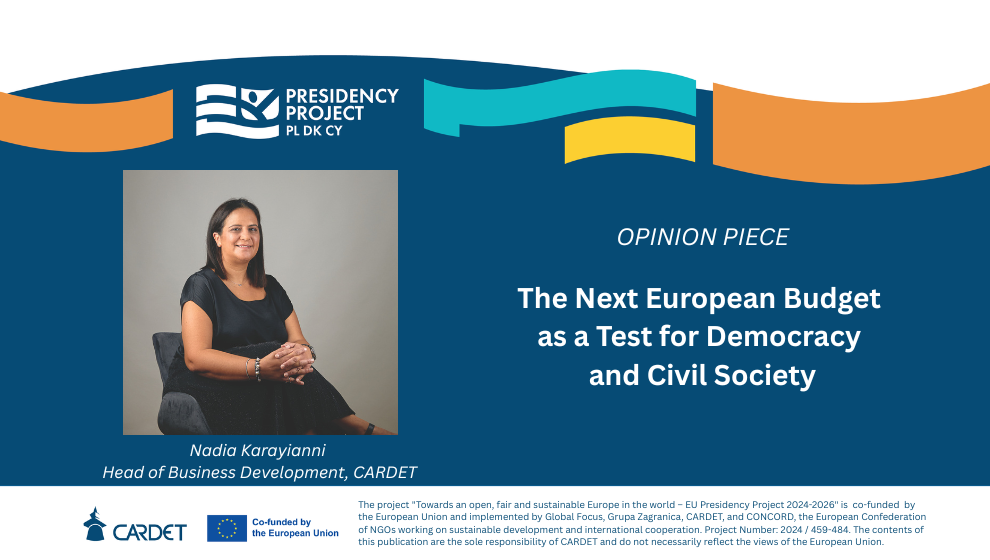
The Next European Budget as a Test for Democracy and Civil Society

The European Union is currently at a critical stage in shaping its next Multiannual Financial Framework (MFF) for the period 2028-2034. As the EU’s long-term budget, the MFF will determine how European resources are allocated over the next seven years, influencing investments in social cohesion, competitiveness, the green and digital transitions, education, democracy, human rights, external action, and support for citizens.

For civil society, this discussion is neither technical nor distant. It is deeply political and directly connected to the kind of Europe we want to build in the years ahead. The European budget does not simply reflect financial priorities. It reflects values. It demonstrates what Europe chooses to protect, strengthen, and maintain at the heart of its political action.

Over recent years, civil society organisations at both European and local levels have played a vital role in supporting vulnerable groups, defending human rights, strengthening social cohesion, promoting sustainable development, and keeping democratic dialogue alive. At the same time, they operate in an increasingly challenging environment characterised by limited resources, growing administrative burdens, shrinking civic space, successive crises, and the need to respond rapidly to emerging social challenges.

This is why the debate surrounding the MFF 2028-2034 has mobilised a broad range of organisations and European networks. Networks such as CONCORD Europe, Civil Society Europe, SOLIDAR, and many other European platforms have made it clear that support for civil society cannot be treated as a supplementary or secondary issue. Rather, it must be recognised as a prerequisite for a resilient, democratic, and socially just Europe.

In Cyprus, this discussion has also been advanced through the EUPP5 programme, “Towards an Open, Fair and Sustainable Europe in the World”, with CARDET coordinating awareness-raising, dialogue, and advocacy activities at both national and European levels. Cypriot civil society has contributed to a broader European effort to ensure that the voices of organisations are heard before key decisions are finalised. These discussions have focused on funding mechanisms, access to EU programmes for NGOs, the protection of human rights, and the need for organisations to participate in the design of policies that affect them.

These collective efforts have already yielded results. The proposed AgoraEU programme, which aims to bring together and strengthen the fields of culture, media, and civil society, represents an important development. The provision of increased funding for values, democracy, equality, rights, and citizen participation demonstrates that sustained advocacy by civil society at the European level has had a tangible impact. The discussion surrounding CERV+, within the framework of AgoraEU, acknowledges that organisations working on rights, democratic participation, and equality require stronger, more accessible, and more predictable funding mechanisms.

At the same time, the adoption of the new EU Civil Society Strategy marks another positive step forward. The creation of a new dialogue platform for civil society, the development of tools to monitor and protect civic space, and the recognition of the need for sustainable funding contribute to a clearer political framework. For the first time, support for civil society is being more explicitly linked to the resilience of democracy across Europe.

Despite these positive developments, the work is far from complete. Experience has shown that strategic recognition alone is not enough unless it is accompanied by clear implementation mechanisms, adequate resources, and meaningful participation by organisations in decision-making processes. The critical question is no longer whether the EU recognises the role of civil society. The real question is who will implement this strategy, how it will be implemented, according to what timeline, through which indicators, and with what accountability mechanisms.

Similarly, several important issues within the MFF negotiations remain unresolved. The final allocation of funding across different categories of European programmes has yet to be determined. Negotiations within the Council and with the European Parliament are ongoing, while funding arrangements and broader horizontal issues remain subject to political negotiation. This means that civil society organisations must continue to closely monitor developments, contribute evidence-based recommendations, and cooperate at both European and national levels.

For Cyprus in particular, the discussion has an additional dimension. The priorities established within national and regional plans, especially regarding structural funds and social cohesion investments, will largely determine whether the needs of civil society are meaningfully integrated or remain marginalised. NGOs in Cyprus require access to more flexible funding, support for organisational development, opportunities to participate in policy design, enhanced transparency, and recognition of their role as partners of the state rather than merely implementers of individual projects.

Civil society should not be called upon only during times of crisis. Nor should it be recognised only when it reaches communities and individuals beyond the scope of public services. It must have a place in policy design, consultation, monitoring, and evaluation processes that directly affect citizens.

The coming period will be crucial. Discussions on the MFF will continue at both technical and political levels, while the decisions taken will directly shape the operational capacity of civil society organisations from 2028 onwards. The mobilisation seen so far has demonstrated that when organisations collaborate, support their positions with evidence, and speak with a common voice, they can influence the European agenda. However, success will not be measured solely by what is written in policy documents. It will be determined by whether commitments are translated into real resources, accessible programmes, and meaningful participation.

The next European budget must ensure that human rights, democracy, and civil society remain at the core of European action. Not merely as rhetorical commitments, but as funding, political, and institutional priorities.

For Cyprus and for Europe, this is the real challenge: building a Union that invests not only in competitiveness and security, but also in the people, communities, and organisations that keep democracy alive in practice.

The project “Towards an open, fair and sustainable Europe in the world – EU Presidency Project 2024-2026” is co-funded by the European Union and implemented by Global Focus, Grupa Zagranica, CARDET, and CONCORD, the European Confederation of NGOs working on sustainable development and international cooperation. Project Number: 2024 / 459-484. The contents of this publication are the sole responsibility of CARDET and do not necessarily reflect the views of the European Union.

Nadia Karayianni,
Head of Business Development, CARDET

The article was published at the PolicyPress.