Article published at the Global Focus website.
As Cyprus holds the EU Council Presidency, civil society actors, researchers, and policymakers gathered in Nicosia to exchange perspectives and explore responses to some of Europe’s most pressing challenges, from democratic backsliding to increasing pressure on civic space.
Spring had fully arrived in Nicosia. Orange trees were in bloom, and the city carried that Mediterranean rhythm where conversations linger and gestures are expansive. Inside an amphitheatre at the University of Nicosia, however, the tempo shifted. The room filled quickly with participants from across North Africa, Europe, and the wider Mediterranean region. Conversations overlapped, hands reached out in greeting, and cameras quietly repositioned themselves toward the stage as the Euro-Mediterranean Civil Society Conference began.
At the same time, less than an hour away, Europe’s heads of state and government were gathering for an EU summit shaped by war, energy security, and economic uncertainty. While the settings differed, the questions were strikingly similar: how the EU navigates a world in crisis, and how trust, rights, and long-term solutions can be upheld at a time when short-term pressures often dominate. The conference formed part of the European Presidency Project, which follows the rotating EU presidencies and aims to strengthen the role of civil society in European development policy.
Civil society as a bridge-builder: citizen diplomacy in practice
The discussions did not remain confined to conference rooms. At the Bank of Cyprus Cultural Foundation, we were invited into the exhibition Cyprus Insula: History – Memory – Reality, where the island’s past and present unfolded through layered narratives. One installation stayed with us. A green line stretched along the wall, marking the border that has divided Cyprus since 1974. Yet it did more than illustrate separation. It traced a parallel story.
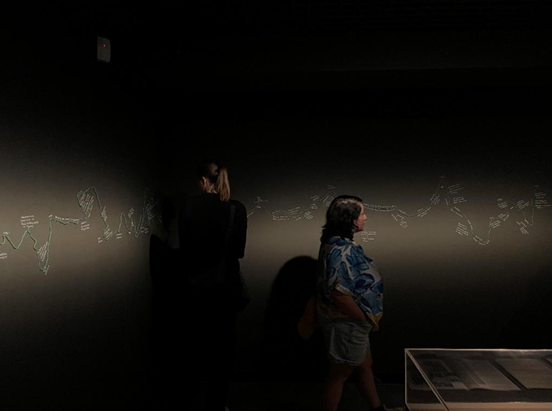
Along the line, moments of civil society action appeared: initiatives, collaborations, and peacebuilding efforts that had, over time, sought to reconnect what history and politics had pulled apart. It was not a dramatic display, but a quiet accumulation of efforts, each one small in isolation, yet powerful in continuity.
The exhibition offered a tangible illustration of citizen diplomacy in practice: the slow, often invisible work of building trust through relationships and dialogue – the kind of diplomacy that doesn’t only happen through political meetings or formal negotiations.
A civic space under pressure
“Democratic participation is fragmented. Trust in institutions is under pressure. And war is preferred over peace.”
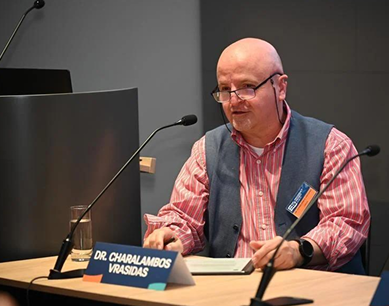
With this stark assessment, Charalambos Vrasidas, Executive Director of CARDET, opened the conference. His words set the tone for two days of discussions shaped by both urgency and reflection.
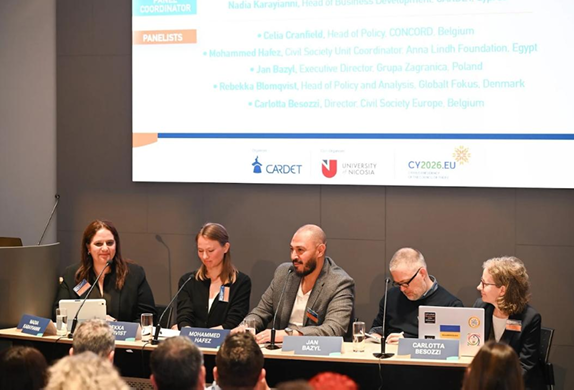
The opening panel focused on the conditions for civil society in a shifting democratic landscape. Participants highlighted that while shrinking civic space is widely discussed, it does not unfold uniformly. Jan Bazyl from the Polish platform Grupa Zagranica pointed out that in parts of Central and Eastern Europe, operating under pressure has long been the norm rather than a new development.
Mohammed Hafez from the Anna Lindh Foundation drew attention to another shift: the growing difficulty of maintaining direct and meaningful engagement with local communities: “In our context, it has become increasingly difficult to maintain direct contact with the communities we work for,” he explained, describing how access, dialogue, and trust can no longer be taken for granted.
Across the discussions, a shared concern emerged that civil society’s role is increasingly questioned and must constantly be explained. As Carlotta Besozzi from Civil Society Europe noted, organisations are spending more time demonstrating their value, often in terms that do not easily capture the social and democratic contributions they make.
Between urgent crises and long-term solutions
The broader geopolitical context was never far from the conversations at the civil society conference in Nicosia. Ongoing conflicts, pressure on multilateral institutions, and global uncertainty shaped the discussions throughout the conference.
Cyprus itself had recently experienced the proximity of these tensions, including a drone attack on the British airbase RAF Akrotiri. The incident served as a reminder that geopolitical instability is not abstract, but something that is very close to home. These dynamics framed the conference’s final panel on the future of the Mediterranean. Bringing together researchers and experts in international politics, security, and development, the panel explored how shifting alliances and regional tensions are reshaping the conditions for cooperation, security, and development.
The room was notably engaged, with participants leaning forward, questions forming even before the discussion concluded. A recurring theme was the tension between immediate responses and long-term strategies. Several panelists pointed out that crises tend to drive political attention toward short-term solutions. Yet, precisely in such moments, maintaining a long-term perspective becomes even more essential.
Civil society, alongside research and knowledge institutions, was highlighted as playing a crucial role in sustaining attention to structural challenges, including rights, sustainability, and inclusive development. “Diplomacy is not just important. It is the only way forward,” said Dr. Harry Tzimitras, Director of the PRIO Cyprus Centre. He also challenged narrow understandings of security: “We need to stop thinking about security in narrow terms. Security is also about climate, rights, and equality.”
Collaboration as a prerequisite
Back in the conference space, between sessions and over shared meals, conversations continued. The atmosphere reflected a distinct sense of Cypriot hospitality, generous, informal, and intentionally relational. Long tables, shared dishes, and unhurried exchanges created space for connections that extended beyond formal panels.
Across these interactions, one message remained consistent: no single actor can address these challenges alone. Collaboration across civil society, public institutions, researchers, and private actors was repeatedly emphasized as essential. Not as an abstract ideal, but as a practical necessity in a complex and interconnected world.
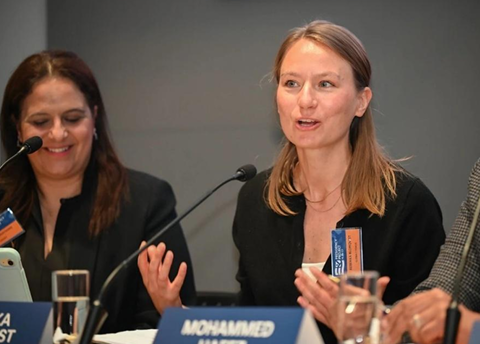
As Rebekka Blomqvist from Global Focus put it: “We need to look inward, remain open, and build new alliances. How do we get more people to engage with these issues and recognise the importance of civil society’s role?” The conversations in Nicosia pointed toward a shared understanding: that advancing long-term, rights-based, and sustainable solutions requires both the ability to respond to immediate crises and the commitment to keep sight of the broader direction.
The project “Towards an open, fair and sustainable Europe in the world – EU Presidency Project 2024-2026” is co-funded by the European Union and implemented by Global Focus, Grupa Zagranica, CARDET, and CONCORD, the European Confederation of NGOs working on sustainable development and international cooperation. Project Number: 2024 / 459-484. The contents of this publication are the sole responsibility of CARDET and do not necessarily reflect the views of the European Union.

Website
https://cardet.org/eupp5/Target Groups
Academics, Professionals, Youth, Adults, Policy makers, Public bodies, General public, CSO'sEducation Level
VET, Adult education