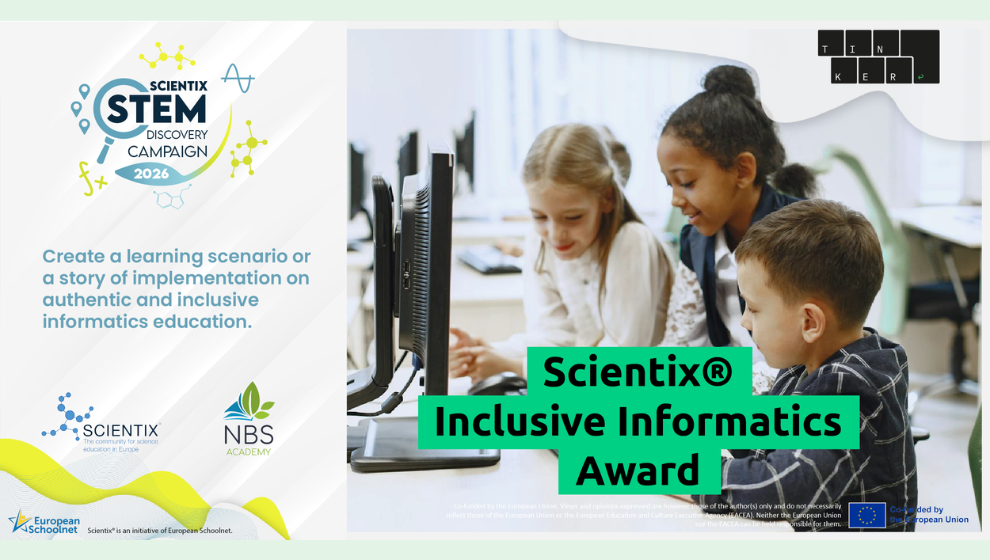
The TINKER project proudly supported the Scientix Authentic and Inclusive Informatics Award, presented as part of the 2026 STEM Discovery Campaign, recognising educators who promote authentic, inclusive and engaging approaches to informatics education.
The annual Scientix STEM Discovery Campaign, co-organised this year with the support of the NBS Academy project, ran from 1 February to 30 April 2026. The initiative brought together educators, schools, universities, libraries, organisations and youth clubs from more than 50 countries, resulting in over 9,000 STEM education activities that reached more than 200,000 teachers and 800,000 students.
As part of the Scientix Awards initiative, TINKER supported the Authentic and Inclusive Informatics Award, inviting educators to showcase learning scenarios and classroom practices inspired by authentic learning, gender-inclusive teaching, the TINKER Toolkit and the TINKER MOOC. More than 140 submissions were received, with 83 entries shortlisted for the award.
The 2026 award winners are:
- Stavroula Lada (Greece) for Crafting a Smart Garden Watering Helper, an innovative learning scenario demonstrating authentic informatics learning through real-world problem solving.
- Eda Aygün (Türkiye) for Digital Balance: Algorithms and Statistics, a learning scenario combining computational thinking with statistical concepts in an inclusive learning environment.
Both winners have been invited to participate in the upcoming Science Projects Workshop at the European Schoolnet office in Brussels, where they will exchange ideas, collaborate with fellow educators, and explore innovative STEM teaching practices through networking and peer learning activities.
Alongside its contribution to the Scientix Awards initiative, TINKER has also strengthened teachers’ capacity through its international online course, Teach Informatics Using Authentic Learning and Gender Inclusion. Running until 29 April 2026, the MOOC brought together more than 1,200 participants from 67 countries across Europe and beyond to explore gender-inclusive and authentic approaches to teaching informatics.
Designed for pre-service and in-service informatics and STEM teachers, non-formal educators and educational technology professionals, the four-module course combined practical activities, interactive learning materials and two live online events. Participants explored the TINKER framework and toolkit, discovered practical gender-inclusive teaching strategies, and designed and assessed authentic informatics learning scenarios for classroom implementation.
The course outcomes highlighted the value of the learning experience. Participants reported greater confidence in applying gender-inclusive and authentic learning approaches in informatics education, as well as a stronger ability to reflect on and further develop their own teaching practice. Many also expressed their intention to integrate the course’s ideas, strategies and examples into their everyday teaching to create more inclusive and engaging learning experiences. As one participant noted:
“What I enjoyed most about this course was its strong connection between informatics, authentic learning and inclusion. I especially appreciated how the course encouraged us to think about coding and digital skills as tools for solving meaningful real-world problems”.
Although the live edition of the MOOC has concluded, the course remains accessible through the European Schoolnet Academy platform.
Check out the course content: Teach informatics using authentic learning and gender inclusion | European Schoolnet Academy, and get inspired to create more inclusive and authentic learning experiences!ntic learning and gender-inclusive pedagogies, helping address persistent gender imbalances in computer science education.
For more information visit the project’s website.

Website
https://tinker-project.eu/Target Groups
Teachers, Students, School leaders, School staff, Academics, Researchers, Professionals, Policy makers, TrainersEducation Level
Primary education, Secondary