“AI won’t replace teachers — but teachers who use AI may replace those who don’t.“
For centuries, the teacher occupied an almost sacred role: the custodian and transmitter of knowledge. That archetype is dissolving — not because teachers have become less important, but because artificial intelligence is rapidly absorbing the parts of teaching that were, in truth, always mechanical. [1] What remains — and what AI cannot replicate — is the irreducibly human work of guiding curiosity, nurturing critical thought, and holding the ethical line. The classroom of 2025 does not need a teacher who knows everything. It needs one who knows how to build an environment where students can think.
‘’The more compelling narrative is not AI automating education, but teachers working with AI to craft transformative learning experiences.’’
World Economic Forum, 2025 [1]
The Automation Opportunity — and Its Shadow
The productivity gains are real and already in motion. [1] Roughly 60% of teachers now use AI tools in their classrooms to handle routine tasks — grading multiple-choice assessments, tracking progress, generating practice exercises — freeing time for deeper instructional work. [1] The global AI in education market is projected to leap from $5.18 billion in 2024 to $112.3 billion by 2034. [1] Yet automation carries a shadow risk: that teachers begin to cede the judgement, care, and accountability that make education meaningful. UNESCO’s 2024 AI Competency Framework for Teachers warns explicitly that over-reliance on AI could cause educators to lose key professional competencies if they delegate too heavily to algorithmic systems. [3]
Three Roles Teachers Must Now Own
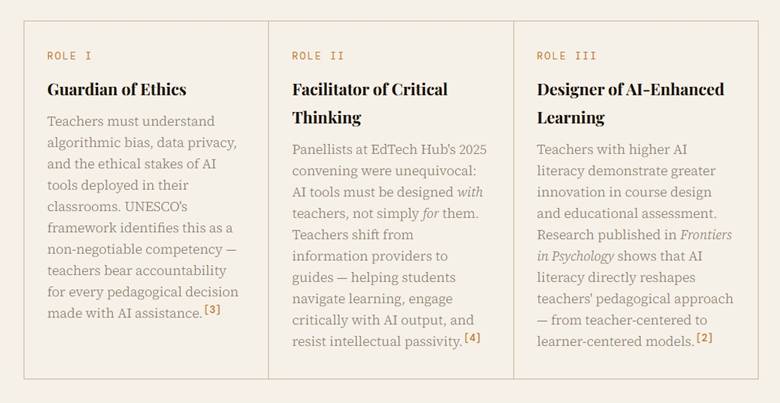
As AI absorbs the transactional, teachers are stepping into three defining roles — each one distinctly human in character.
The Competencies That Cannot Wait
UNESCO’s AI Competency Framework for Teachers — launched in September 2024 — defines five dimensions every educator must develop: a human-centred mindset, AI ethics, foundational AI knowledge, AI pedagogy, and professional AI learning. [3] These are not optional electives. Research from the European Journal of Teacher Education (2025) confirms that nearly half of self-reported digitally literate teachers have still not integrated AI into their practice, underscoring a knowing-doing gap that professional development must close. [5]
Teachers also need what no framework can fully script: the moral imagination to ask whether an AI tool should be used before asking how. As the World Economic Forum has observed, teaching involves far more than imparting information — AI should augment, never replace, the teacher’s role. [6]
The 21st-century teacher is, above all, a learning architect — someone who designs conditions in which human minds grow, integrates AI as a powerful but subordinate instrument, and keeps ethics at the centre of every choice. The transition is demanding, but the invitation is extraordinary: to become not less essential in an age of AI, but more deliberately, more irreplaceably human.
Learn more about the project here: https://infinite-erasmus.eu/
Sources & References
- World Economic Forum. (2025, January). How AI and human teachers can collaborate to transform education. weforum.org
- Frontiers in Psychology. (2025, October). Promoting teaching innovation among university teachers through AI literacy from the perspective of planned behavior. frontiersin.org
- UNESCO. (2024). AI Competency Framework for Teachers. unesdoc.unesco.org
- EdTech Hub. (2025, May 21). AI Tutors and Teaching: How Might the Role of the Teacher Change in an Age of AI? edtechhub.org
- Heine, S. & König, J. (2025). Applying artificial intelligence in teacher education: preservice teachers’ attitudes and reflections in using ChatGPT for teaching and learning. European Journal of Teacher Education, 48(5). tandfonline.com
- World Economic Forum. (2024, April). The future of learning: AI is revolutionising education 4.0. weforum.org

Website
https://infinite-erasmus.eu/Target Groups
Academics, Researchers, Policy makers, Adult educatorsEducation Level
Higher education