Building a Fairer, More Sustainable World: The European Union’s Vision for International Partnerships

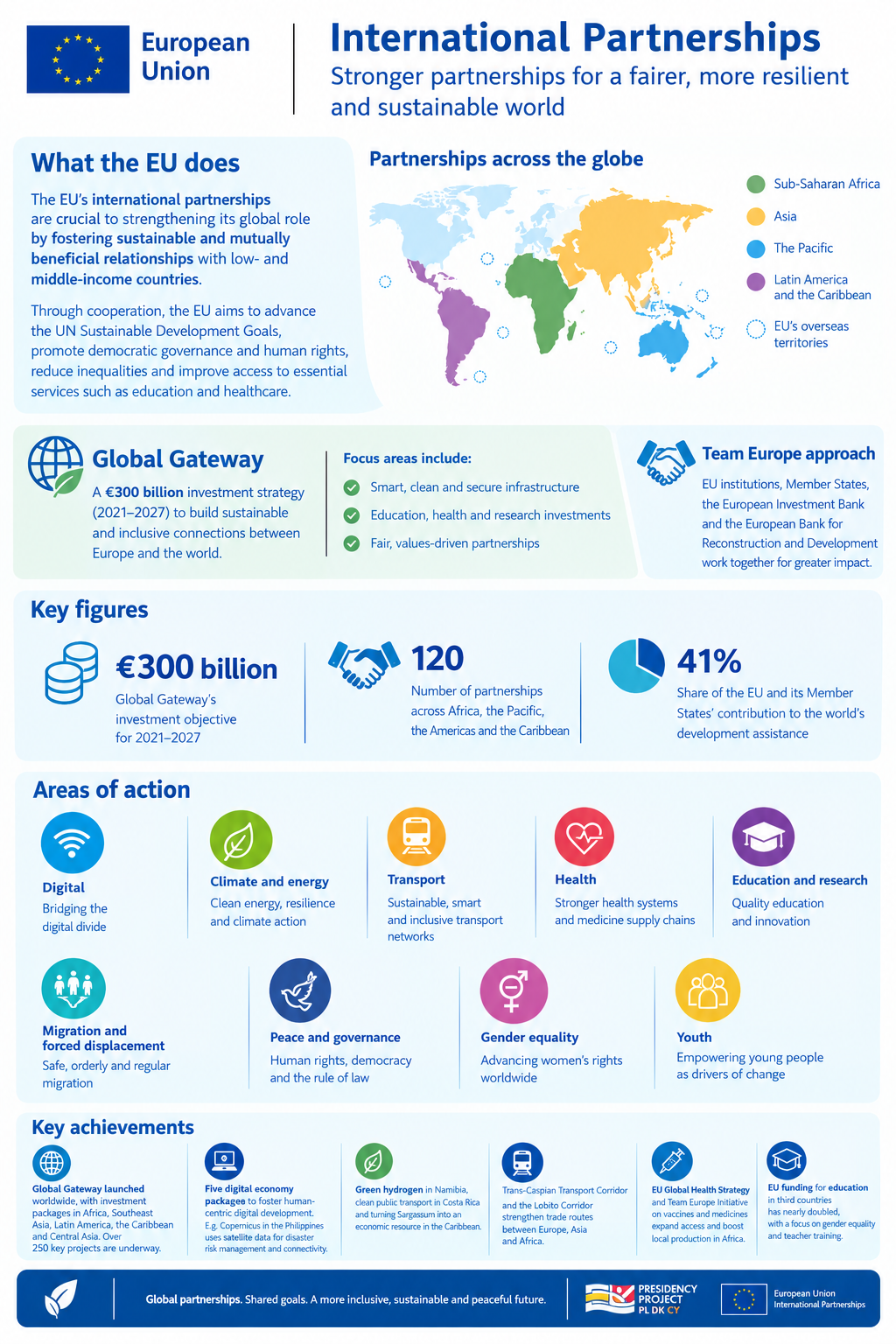
In an increasingly interconnected world, global challenges require collective action. Through its international partnerships, the European Union (EU) is strengthening its global presence by building sustainable, mutually beneficial relationships with low- and middle-income nations. These partnerships aim to advance the UN Sustainable Development Goals (SDGs), uphold democratic governance and human rights, reduce systemic inequalities, and guarantee access to vital services like education and healthcare.
Global Reach and the “Team Europe” Approach
The EU’s partnership network spans multiple key regions across the globe, including Sub-Saharan Africa, Asia, the Pacific, Latin America and the Caribbean, as well as the EU’s overseas territories.
To deliver maximum impact, these efforts are implemented via a joint Team Europe approach. This initiative pools resources, expertise, and funding from:
- European Union institutions
- EU Member States
- The European Investment Bank (EIB)
- The European Bank for Reconstruction and Development (EBRD)
By coordinating actions among these institutions, Team Europe ensures a unified, high-impact presence in partner regions.
The Core Drive: Global Gateway
At the center of this cooperation strategy lies the Global Gateway, a €300 billion investment strategy designed for the period 2021–2027. The strategy aims to construct sustainable, inclusive connections linking Europe to the rest of the world. Its core focus areas include:
- Smart, Clean, and Secure Infrastructure: Building future-proof energy, transport, and digital connectivity.
- Education, Health, and Research: Directing long-term investments into human capital and innovation.
- Values-Driven Partnerships: Ensuring fair, transparent agreements that support local communities.
By the Numbers: Impact at a Glance
| Metric | Detail / Figure |
| Global Gateway Budget | €300 billion in investment objectives (2021–2027) |
| Active Partnerships | 120 partnerships across Africa, the Pacific, the Americas, and the Caribbean |
| Development Assistance Share | 41% of the world’s total development assistance is provided by the EU and its Member States |
Targeted Areas of Action
To drive progress across diverse sectors, the EU focuses its international efforts on nine priority areas:
- Digital: Bridging the digital divide and expanding technological accessibility.
- Climate and Energy: Accelerating clean energy transitions, climate resilience, and green action.
- Transport: Creating sustainable, smart, and inclusive transport networks.
- Health: Strengthening global health systems and securing resilient medicine supply chains.
- Education and Research: Boosting quality education, training, and innovation hubs.
- Migration and Forced Displacement: Supporting safe, orderly, and regular migration channels.
- Peace and Governance: Promoting human rights, democratic principles, and the rule of law.
- Gender Equality: Advancing women’s rights and equity worldwide.
- Youth: Empowering young people as main drivers of social and economic change.
Key Tangible Achievements
The EU’s strategy has translated into concrete, transformative projects around the globe, with over 250 key projects underway:
- Global Gateway Rollout: Investment packages deployed across Africa, Southeast Asia, Latin America, the Caribbean, and Central Asia.
- Digital Economy Packages: Supporting human-centric digital growth, including utilizing Copernicus satellite data in the Philippines for disaster risk management and connectivity.
- Green Energy & Sustainability: Developing green hydrogen infrastructure in Namibia, implementing clean public transport in Costa Rica, and turning invasive Sargassum seaweed into an economic resource in the Caribbean.
- Strategic Transport Corridors: Strengthening trade routes linking Europe, Asia, and Africa via the Trans-Caspian Transport Corridor and the Lobito Corridor.
- EU Global Health Strategy: Team Europe initiatives focusing on vaccine and medicine access while boosting local manufacturing capacities across Africa.
- Educational Development: Nearly doubling EU funding for education in third countries, prioritizing gender equality and teacher training.
Through shared goals and joint investments, European international partnerships continue to pave the way toward a more inclusive, sustainable, and peaceful future.