The Euro-Mediterranean CSO Conference, held on 23 and 24 April 2026 in Nicosia, concluded with great success, highlighting the pivotal role of civil society across Europe and the wider Mediterranean region.
The Conference, organised by CARDET as the national coordinator of the European programme EUPP5 and held under the auspices of the Secretariat of the Cyprus Presidency of the Council of the EU, brought together representatives of civil society organisations, institutional stakeholders, academia, international organisations, and youth from across the Euro-Mediterranean region. The strong participation reaffirmed the Conference’s role as a key platform for dialogue, knowledge exchange, and the sharing of best practices.
During the first day, discussions focused on critical issues such as the protection of civic space, challenges in democratic participation, and the enhanced role of organisations in promoting social cohesion and sustainable development. Additional themes included education for global citizenship, migration and social inclusion, mental health in the modern digital environment, as well as funding models and the sustainability of civil society organisations.
The conference opened with welcome remarks by Panagiotis Palates, Commissioner of the Citizen, Cyprus, Dr. Charalambos Vrasidas, Executive Director, CARDET, and Dr. Marinos Papaioakeim, Strategic Partnerships and Development Lead, CARDET, highlighting the importance of collaboration in addressing shared regional challenges.
Panel I – The Shrinking of Civic Space: Challenges, Risks, and the Way Forward, coordinated by Nadia Karayianni, featured Mohammed Hafez, Jan Bazyl, Rebekka Blomqvist, and Carlotta Besozzi, who explored the increasing pressures on civic space and the urgent need to safeguard democratic participation.
Panel II – The Role of Civil Society in Achieving the Sustainable Development Goals (SDGs), coordinated by Chara Triteou, brought together Marta Garcia-Haro, Susana Fonseca, Natasa Ioannou, Dr. Theodoros Zachariadis, and Anna Dorangricchia, highlighting the critical contribution of civil society to inclusive and sustainable development.
The Fireside Chat on Global Citizenship Education, coordinated by Dr. Marios Antoniou, with Francesca Vanoni, underscored the role of education in shaping active, informed, and responsible citizens.
Panel Discussion III – Migration, Skills Development and Social Inclusion, coordinated by Irene Theodoulou, featured Natasa Xenophontos Koudouna, Dr. Başak Yavçan, Mariavittoria Garlappi, and Gemma Aubarell, focusing on turning migration challenges into opportunities for growth and integration.
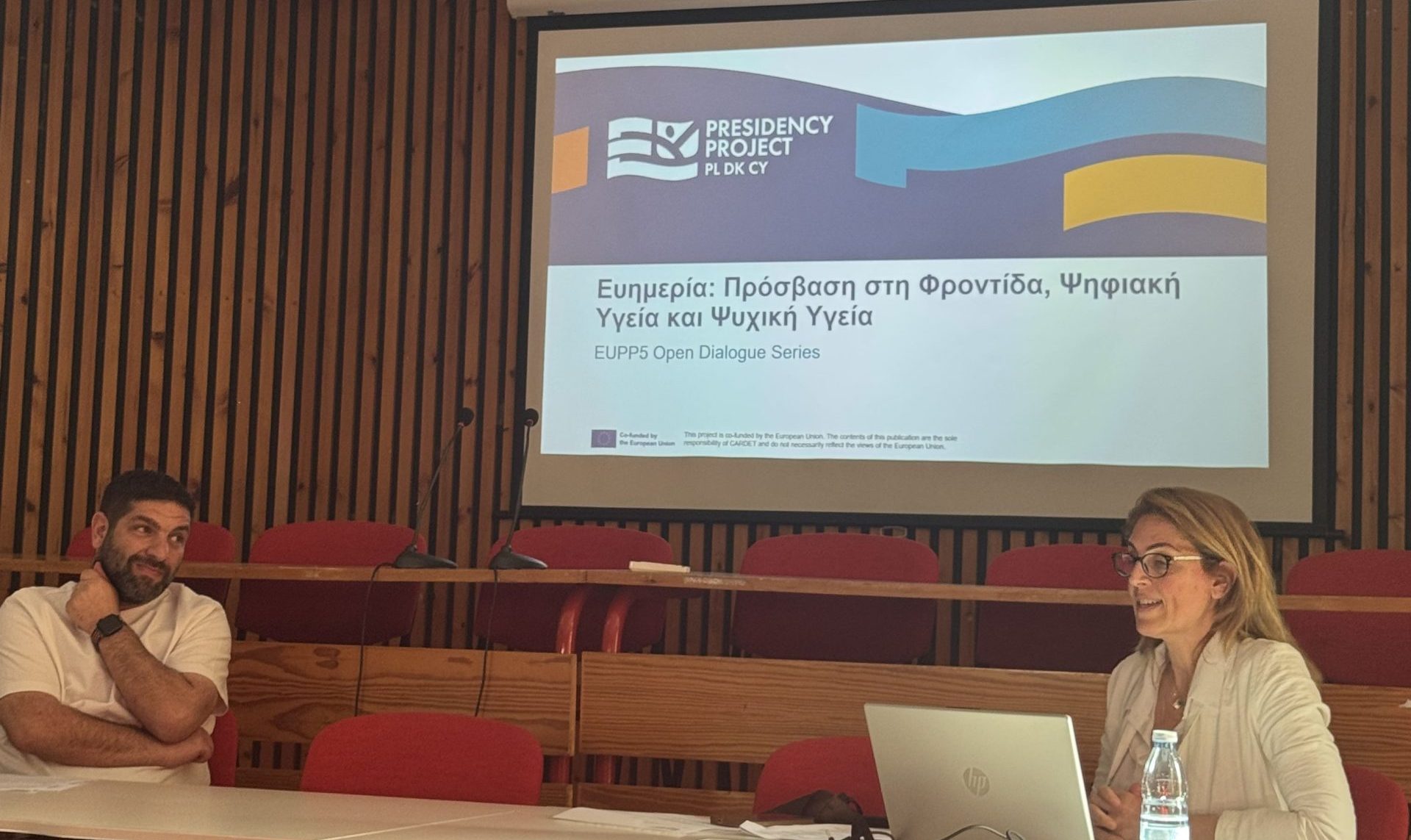
A pre-recorded intervention by Loucas Fourlas, Member of the European Parliament, led into Panel Discussion IV – Digital Mental Health: Challenges and Responses, coordinated by Dr. Charalambos Vrasidas, with Kadri Soova, Dr. Joseph Duffy, and Alexandros Tifas, addressing youth wellbeing in an increasingly digital world.
The day concluded with Panel Discussion V – Funding for Civil Society Organisations, coordinated by Dr. Eria Makridou, featuring Nenad Bogdanovic and Yiannis Trimithiotis, who explored innovative and sustainable funding pathways for civil society.
The second day continued with equally substantive thematic sessions, addressing, among others, the role of education in shaping active and responsible citizens, and fostering partnerships across the Euro-Mediterranean region. Particular emphasis was also placed on the impact of geopolitical developments and the digital transition, including the opportunities and challenges arising from the use of artificial intelligence.
The day opened with a keynote by Dr. Aravella Zachariou, who delivered a compelling address on The Role of Education in Shaping Responsible Citizens, highlighting education as a cornerstone for sustainable and inclusive societies.
This was followed by a keynote and fireside discussion on AI for Social Good: Opportunities and Ethical Challenges for Civil Society, featuring Dr. Demetris Skourides, Chief Scientist, Cyprus and coordinated by Dr. Charalambos Vrasidas, exploring how artificial intelligence can drive innovation while addressing critical ethical considerations.
A pre-recorded keynote by Michael Karnitschnig on EU–MENA Partnerships in a Changing Geopolitical Landscape: Challenges, Priorities, and Opportunities provided valuable insights into regional cooperation amid evolving global dynamics.
Panel Discussion VI – The Changing Mediterranean: Geopolitical Tensions, Challenges, and Opportunities, coordinated by Dr. Marinos Papaioakeim, brought together Dr. Zenonas Tziarras, Dr. Harry Tzimitras, and Dr. Michalis Kontos, offering a comprehensive analysis of the region’s shifting geopolitical landscape.
The conference concluded with closing remarks and a networking lunch, marking the end of two impactful days of dialogue, knowledge exchange, and partnership-building.
The discussions underscored the need to strengthen collaboration and adopt innovative approaches capable of addressing contemporary societal challenges. Through meaningful dialogue and the connection of stakeholders and citizens, the Euro-Mediterranean CSO Conference actively contributed to shaping proposals and strategies for a more just, inclusive, and resilient society in the Euro-Mediterranean region.
The Conference was organised by CARDET in collaboration with University of Nicosia, within the framework of the European programme EU Presidency Project (EUPP5).
Supporters: (CRoLEV) – UCLAN, Civil Society Advocates, Commissioner for the Citizen Office, European Parliament Liaison Office in Cyprus, Foundation Parliamentary Democracy, Institute for Studies of Politics & Democracy, NGO Support Center, Oxygen for Democracy, Police Lab, Red Cross Cyprus
Media Sponsors: DIAS Group, Policypress, INBusiness, Gold
The full agenda of the Conference is available here: https://drive.google.com/file/d/1DGql_W8JTGE0TDF4PfvMfhSfq7D7SDri/view
Photo Gallery: https://www.imhbusiness.com/en/gallery-euro-mediterranean-cso-conference-2026/
The project “Towards an open, fair and sustainable Europe in the world – EU Presidency Project 2024-2026” is co-funded by the European Union and implemented by Global Focus, Grupa Zagranica, CARDET, and CONCORD, the European Confederation of NGOs working on sustainable development and international cooperation. Project Number: 2024 / 459-484. The contents of this publication are the sole responsibility of CARDET and do not necessarily reflect the views of the European Union.
To learn more about the EUPP5, please visit: https://cardet.org/eupp5/
The article was published at the PolicyPress
Website
https://cardet.org/eupp5/Target Groups
Academics, Professionals, Youth, Adults, Policy makers, Public bodies, General public, CSO'sEducation Level
VET, Adult education